


| Posted On 20:21 by El NACHO | 0 comments |
| Posted On 17:44 by El NACHO | 0 comments |
25 Shia Muslim pilgrims have been killed after gunmen opened fire on a bus in western Pakistan, officials said. The pilgrims were going through Mastung district in Baluchistan province, en route to the Iranian border, when the attack occurred, said a senior district official, Saeed Umrani. Two motorcycles blocked the path of the bus and three gunmen stormed the vehicle, opening fire on the roughly 40 pilgrims inside, said a local tribal police officer, Dadullah Baluch, after interviewing survivors and eyewitnesses. At least 25 people were killed and more than a dozen injured in the attack on Tuesday, he added. The dead and wounded were being taken to a hospital in Quetta, about 35 miles to the north, he said. Pakistan is a majority Sunni Muslim state. Although most Sunnis and Shias live there relatively peacefully, extremists on both sides often target each other's leaders and activists. The Sunni-Shia schism over the true heir to the prophet Muhammad dates back to the seventh century.
| Posted On 17:37 by El NACHO | 0 comments |
A Taliban suicide bomber with concealed explosives in a turban on Tuesday assassinated former Afghan president Burhanuddin Rabbani, who was leading government peace efforts, police said. The bomber struck during a meeting at the Kabul home of Rabbani, who was last year appointed chief of the Afghan High Peace Council that President Hamid Karzai tasked with negotiating with the Taliban. His death is the most high-profile political assassination since the 2001 US-led invasion ousted the Taliban from power and comes just two months after Karzai's brother Ahmed Wali Karzai was also killed. The attackers arrived at Rabbani's house with Mohammad Massom Stanikzai, Rabbani's deputy, for a meeting before the turban bomber detonated his explosives, according to one source amid conflicting reports of the incident. A member of the High Peace Council, Fazel Karim Aymaq, said the men had come with "special messages" from the Taliban and were "very trusted." Kabul criminal investigations chief Mohammad Zaher said two men "negotiating with Rabbani on behalf of the Taliban" arrived at his house, one with explosives hidden in his turban. "He approached Rabbani and detonated his explosives. Rabbani was martyred and four others including Massom Stanikzai (his deputy) were injured." The bomber struck close to the US embassy, making it the the second attack within a week in Kabul's supposedly secure diplomatic zone. The killing prompted Afghan President Hamid Karzai to cut short his visit to the United States, his spokesman said, adding he was still expected to meet US President Barack Obama as scheduled before leaving. An AFP reporter saw an ambulance at the scene and said police had blocked off surrounding roads. The reporter also heard guards at the house shouting for an ambulance for Rabbani's deputy. Two of the former president's political allies, who did not want to be named and speaking before police confirmed Rabbani's death, wept as they told AFP he had been killed. "Yes, he is dead," said one of the two sources by telephone. The Taliban were not immediately reachable for comment, but the insurgency led by its militia has hit Kabul increasingly hard in recent months. The Pakistani government swiftly condemned the assassination, describing Rabbani as a "friend" with whom Islamabad was working closely on peace efforts. "The people of Pakistan stand by their Afghan brothers and sisters in this moment of grief," a joint statement released by President Asif Ali Zardari and Prime Minister Yousuf Raza Gilani said, just days after the United States accused the Pakistani government of having ties to Taliban faction the Haqqani network. Among the most high-profile attacks was last week's 20-hour siege of the US embassy and the NATO-led International Security Assistance Force (ISAF) headquarters which left 14 people dead. Rabbani was president of Afghanistan from 1992 until the Taliban took power in 1996 and headed a country wracked by civil war. Karzai's brainchild, the High Peace Council was intended to open a dialogue with insurgents who have been trying to bring down his government since the US-led invasion overthrew their regime. The 68-member council, hand-picked by the president, was inaugurated on October 7, 2010, amid mounting reports of secret peace talks with Taliban leaders and key insurgent groups. Delivering his acceptance speech, Rabbani said he was "confident" that peace was possible, according to a statement from the palace. "I hope we are able to take major steps in bringing peace and fulfil our duties with tireless effort and help from God," he was quoted as saying. According to Human Rights Watch, Rabbani is among prominent Afghans implicated in war crimes during the brutal fighting that killed or displaced hundreds of thousands of Afghans in the early 1990s.
| Posted On 19:04 by El NACHO | 0 comments |
Six men have been arrested in connection with one of the most significant intelligence-led counter-terrorism operations this year. The men were detained at or near their homes in Birmingham on suspicion of the commission, preparation or instigation of an act of terrorism in the UK following a joint investigation by both police and MI5. It is understood the investigation relates to suspected Islamist extremism, but it is not thought that an attack or threat was imminent. A seventh person, a 22-year-old woman, was arrested on suspicion of failing to disclose information contrary to the Terrorism Act 2000, police said. West Midlands Police said the "large-scale operation" had been running for some time and had been subject to regular review, adding that the action was necessary "in order to ensure public safety".
| Posted On 09:01 by El NACHO | 0 comments |
British singer Cheryl Cole has flown to Afghanistan to visit U.K. troops serving in the war-torn country. The Girls Aloud star made her way to the country's Helmand Province on Tuesday night (13Sep11) to surprise servicemen and women. Cole underwent special training to prepare for the hostile environment she will tour during her visit, which marks 10 years of British operations in the country. Her morale-boosting trip is being filmed as part of the annual Pride of Britain Awards, which will air on U.K. TV next month (Oct11). A source tells Britain's Daily Mirror, "Cheryl's amazed by the courage of all those serving our country. When she was invited to go out to see them in Afghanistan, she immediately said 'yes'. "She thinks it's such a great cause and they deserve all the recognition they get." Cole has largely been out of the public eye since she was fired from the U.S. version of The X Factor earlier this year (11).
| Posted On 07:31 by El NACHO | 0 comments |
BRITISH tourist has been killed and his wife kidnapped after suspected Somali pirates stormed their villa at an exclusive Kenyan resort. They were attacked by at least five men as they lay in bed in their beachside villa at 2am yesterday. David Tebbutt, 58, is believed to have been shot trying to protect wife Judith, 56, from the raiders. They bundled her into a speedboat and vanished. The couple, from Bishop's Stortford, Herts, had been at the Kiwayu Safari Village just a few hours and were the only guests. The secluded resort is 18 miles from the border with war-ravaged Somalia, notorious for its pirates. Police spokesman Eric Kiraithe said a massive search involving military boats, helicopters and ground forces had begun at dawn. He added: "We are hoping that we will be able to at least find the lady. "We believe it is a kidnap but we are yet to receive any communication from the alleged kidnappers." Pirates tend not to raid on land — and it is rare for them to harm any victims because they want to ransom them. That has led to speculation that the attack could be the work of local Islamic fanatics who wanted to make their mark on the 9/11 anniversary. But police commissioner Mathew Iteere said: "So far we are treating it as a bandit attack. We've not received any hint pointing at a terror group.
| Posted On 07:18 by El NACHO | 0 comments |
His flight reduces the retinue of close family members sticking by Col Gaddafi to just two sons, Saif al-Islam and Mutassim, and his closest aide and brother-in-law, Abdullah Senussi.
Marou Amadou, the Niger justice minister, confirmed he had crossed the two countries’ Saharan border in a convoy of vehicles and been intercepted by local troops.
He said the convoy was continuing to the northern town of Agadez and from there to the capital Niamey, where a number of Touareg tribal leaders formerly loyal to Col Gaddafi have also sought refuge in recent weeks.
His flight will be a further blow to the confidence of those troops remaining loyal to the old regime. Earlier in the day, rebels made advances on the two remaining loyalist hold-outs in northern Libya after a string of Nato bombing raids.
Saadi was one of the more westernised of Col Gaddafi’s family, though no less capricious that the rest. A former footballer, he played twice for Italian Serie A teams, though he was banned for failing a drugs test.
| Posted On 21:09 by El NACHO | 0 comments |

Tripoli: His name of choice was the Brother Leader, though his nearly 42 years of rule were rarely brotherly, and his leadership left one of the world’s most richly endowed countries in shambles.
Now, as the former subjects of Muammar Gaddafi comb through his family’s mansions, farms and seaside villas, the properties are revealing the details of lives lived far removed from the people, ones filled with the signs of their peccadilloes and rivalries.
At one farm, horses wandered by marble statues of lions, tigers and bears, and reindeers grazed by the wood deck of an empty pool. At the home of one son, Sa’adi, there were signs of a life mundane in its seeming frustration. A man who drifted through stints as an athlete, soldier and Hollywood movie producer, Sa’adi kept the English language self-help book Success Intelligence in his master bedroom. Given Gaddafi’s noted flamboyance, the residences of the House of Gaddafi were not quite as grand as people might minor have supposed.
Faux grandeur
They lacked the faux grandeur of Saddam Hussain’s marbled palaces. There are no columns that bear the Gaddafi’s initials, or fists cast in replica of his hands, or river-fed moats with voracious carp.

“For somebody who’s very rich, he was very cheap,” said resident Fuad Gritli, as he drove through a sprawling parcel near the airport known as the Farm, where Gaddafi lived.
In the sanctum of the Farm, there are rolling, irrigated fields. Camels wandered unattended. Still standing was a tent where he met foreign dignitaries, its canvas decorated in pictures of camels and palm trees. “We weren’t allowed to get anywhere near, not even the gate,” Gritli said. “Gaddafi was not living like a rich man, I admit that, said Malek Al Bakouri, a 27-year-old doctor from Tripoli, as he drove past a guest house where water cascaded from a broken pipe in a city suffering from a shortage of it. “But his sons, all the people in his tribe, and all the families around him lived good, and they lived good for 40 years.”
Gaddafi's sons’ behaviour would have made a reality show proud — Sa’adi was a professional soccer player, and Hannibal repeatedly had brushes with the law in Europe. But the sons’ villas on a sand bluff overlooking the Mediterranean had a distinctly 1970s feel. They were not lavish; the brown paint on the patio decks was peeling. But to the young fighters roaming through Hannibal’s quarters — furnished overwhelmingly in whites and blacks, and ringed with plastic grass — there was just enough luxury to inspire envy. “We’ve got to take this over!” said Bahaeddin Zintani, a 23-year-old revolutionary who took turns with his brother lying in bed and posing for pictures before a home gym fitted with a mirror. “This is the first time I’ve even seen anything like this.”
On a black granite bar, there were cases for Johnnie Walker Blue Label and Dom Perignon Rose, all empty.
Muatassim, the fourth-eldest Gaddafi son and the country’s national security adviser, surrounded himself with more luxury. He regularly arrived in a convoy of cars to a farmhouse in the Ain Zara neighbourhood of Tripoli protected by high walls and gates on four sides that were made to look like cinder-block walls. A driveway with a fountain featuring four-horse drawn carriages, and then, an ostentatious pool bungalow, with Roman columns at the entrance and topped by gold domes that looked like Hershey Kisses.
Amid the scattered shards of gilded furniture were relics of Sa’adi’s mundane if coddled life: directions for a battery-powered Barbie doll, mermaid floats that children must have played with in the swimming pool out back, a phrase book of English vocabulary for the finance business. Through his long reign, Gaddafi posed as an ever-struggling revolutionary, his ideas encapsulated in The Green Book. (In one memorable passage, he defended freedom of expression, even if a person chooses “to express his or her insanity.”) But the avowed simplicity never matched his lifestyle, prone as he was to epaulets, billowing robes and shirts emblazoned with green maps of Africa. His all-female contingent of guards was supposedly sworn to celibacy.
At Muammar Gaddafi’s residence in Bab Al Aziziya, his fortress-like preserve in the heart of Tripoli, there was a white binder with hundreds of pages of clippings about him. Graffiti on a wall nearby taunted the Brother Leader, now nicknamed for another distinguishing trait: unmanageable grooming. “Where’s the guy with the crazy hair?” it said.
| Posted On 10:40 by El NACHO | 0 comments |
highest-ranking officer of the former Yugoslav army has been jailed for 27 years by the UN tribunal at The Hague for war crimes. General Momcilo Perisic, who served as chief of staff of the Yugoslav army during the Balkans conflict, was found responsble for murder, persecution and attacks on civilians in Bosnia and Croatia in the 1990s. The tribunal found Perisic, 67, guilty of helping Serb troops plan and carry out war crimes, including the killing of 8,000 Muslim men and boys in Srebrenica and of the 42 month-long siege of Sarajevo. Perisic was also convicted of failing to punish his subordinates for their crimes of murder, attacks on civilians, and injuring and wounding civilians during rocket attacks on Zagreb in Croatia. He was also found guilty of securing financial and logistical support for Serbs in Bosnia and Croatia. Criminally responsible "Momcilo Perisic was found criminally responsible for aiding and abetting murder, inhumane acts, attacks on civilians and persecution on political, racial or religious grounds in Sarajevo and Srebrenica," Justice Bakone Moloto said. Perisic becomes the first Belgrade official to be convicted for Serbia's role in the wars in Bosnia and Croatia, a role the regime in Serbia has always staunchly denied. The court also found Perisic bore command responsibility for the shelling of Zagreb in 1995. The tribunal found evidence that Perisic had had a "collaborative relationship" with Bosnian Serb military commander General Ratko Mladic, and "substantially aided his operations". Perisic had kept General Mladic on the Yugoslav Army payroll list, and personally signed Mladic's promotion to the rank of colonel general in 1994. Mladic is currently on trial at The Hague on charges of crimes including genocide. But the tribunal did not find evidence that Perisic had "exercised effective control" over Mladic or any other Yugoslav Army officer serving in the Bosnian Serb army. Mladic has been indicted for genocide by the Yugoslavia tribunal and was arrested in May this year.
| Posted On 10:38 by El NACHO | 0 comments |
With drawn and gaunt faces, some 30 Egyptians holed up in a modest Libyan hotel speak of the incarceration and torture they suffered at the hands of Muammar Gaddafi’s loyalists. “They told me, ‘You Egyptians, you caused problems in your country, and now you have come to destroy ours’,” said Mahmud Abu Zeid, referring to the popular uprising that ousted neighbouring Egypt’s president Hosni Mubarak in February. “They wanted me to say that I was armed and had encouraged Libyans to rise up against Gaddafi,” he said. The 31-year-old said he was the first Egyptian to have been jailed in Abu Slim, a district of Tripoli that saw some of the fiercest fighting and worst atrocities before Gaddafi lost his grip on the capital late last month. Abu Zeid said the Gaddafi loyalists forced the Egyptians to record confessions that they had triggered the revolt against his regime, before they were eventually freed by revolutionary fighters. “For five months, they gave electric shocks to my son. I was so weak that I was unable to walk, so they dragged me like a sack,” he said, adding, “I ended up recording their message.” Under pressure he “confessed” to having used guns to encourage Libyans to call for the ouster of Gaddafi, he said, adding however that the Libyans who heard the recordings were not fooled. Abu Zeid’s account tallied with that of other refugees at the hotel in Benghazi, the rebellion’s stronghold in eastern Libya, some 600 kilometres (370 miles) from their homeland. “They gave out bread by kicking it at us, and we had a litre (two pints) of water to be shared among a dozen prisoners,” said another Egyptian man who added that he had been shot twice in the leg. It was still difficult for him to walk. Like him, other men in the hotel showed scars and burn marks on their backs they said were the result of torture. Tamer Rad, an Egyptian labourer who worked in Libya for two years, said he had been forced to to drink urine when he asked for water. “I was really thirsty. I asked for water, crying. They told me ‘You want to drink? Here!’ And they poured urine into my mouth. I was handcuffed, I could not resist so I had to drink it,” he said. The 26-year-old said the Egyptians had been stuck in Benghazi for several days and that he now had only one thought — of leaving Libya and returning to Egypt. The group said they fled to Benghazi after being freed on August 21 when anti-Gaddafi fighters broke open several jails as they overran Tripoli. And they had been unable to move on because, they said, the Gaddafi loyalists burned their travel documents and they are unable to contact the Egyptian embassy in Libya. On Monday, the Egyptian foreign ministry said the men would be repatriated on the same day, explaining that they had been forced to stay in Libya after the fall of the regime due to “insecurity on the roads” and the closure of airports.
| Posted On 09:31 by El NACHO | 0 comments |
The threat is unconfirmed but reportedly involves Washington DC and New York, where people are preparing to mark the 10 year anniversary of 9/11, the worst ever terrorist attack on US soil in which nearly 3,000 people died. New York's Mayor Michael Bloomberg said the new threat was uncorroborated, but he asked citizens to report suspicious activity and said that security would be increased at bridges, tunnels and on public transport. He added: "For the record, I plan to take the subway tomorrow morning." 9/11 anniversary The anniversary of 9/11 will be marked by a ceremony at Ground Zero, attended by President Barack Obama as well as former president George W Bush. The White House said President Obama had been briefed on the threat against the United States. It noted that the US government had "enhanced its security posture" ahead of the anniversary. White House spokesman Jay Carney added: "We're hyper-vigilant to this specific report that's just coming in."
| Posted On 23:03 by El NACHO | 0 comments |
British soldiers could face a fresh prosecution over the brutal death of an Iraqi civilian after a scathing report condemned the "shameful" abuse of prisoners in UK custody. A landmark public inquiry concluded that father-of-two Baha Mousa, 26, died after an "appalling episode of serious gratuitous violence" meted out by members of 1st Battalion the Queen's Lancashire Regiment (1QLR). Inquiry chairman Sir William Gage said a number of British officers who could have stopped the abuse, including 1QLR's former commanding officer Colonel Jorge Mendonca, bore a "heavy responsibility" for the "grave and shameful events". He also strongly criticised the "corporate failure" by the Ministry of Defence that led to "conditioning" techniques banned by the UK in 1972, including hooding and making prisoners stand in painful stress positions, being used by soldiers in Iraq. The £13 million public inquiry, which has published its 1,400-page final report, condemned the "lack of moral courage to report abuse" within Preston-based 1QLR. It named 19 soldiers who assaulted Mr Mousa and nine Iraqis detained with him, and found that many others, including several officers, must have known what was happening. The damning report said the violence could not be described as a "one-off" because of evidence that 1QLR troops abused and mistreated Iraqi civilians on other occasions. Lawyers for Mr Mousa's family called for the soldiers responsible for his death to face charges in the light of the findings. Seven members of 1QLR, including Col Mendonca, faced allegations relating to the mistreatment of the detainees at a high-profile court martial in 2006-07. The trial ended with them all cleared, apart from Corporal Donald Payne, who became the first member of the British armed forces convicted of a war crime when he pleaded guilty to inhumanely treating civilians. Payne was acquitted of manslaughter. The legal team for Mr Mousa's relatives and the other detainees believe that evidence in the inquiry's report could form the basis for a new prosecution. Sapna Malik, from law firm Leigh Day and Co, said: "In light of the cogent and serious findings by Sir William Gage, we now expect that the military and civilian prosecuting authorities of this country will act to ensure that justice is done." The Crown Prosecution Service said the inquiry's report had not been referred to it. The Service Prosecuting Authority, which brings military prosecutions, was not available for comment.
| Posted On 23:04 by El NACHO | 0 comments |
Indian authorities say a terrorist attack outside the Indian high court in New Delhi killed at least 11 people and injured 66 others. Police believe the explosive was placed inside a briefcase near a main gate to the high court in New Delhi. The blast is being described as a "medium-intensity bomb." Injured were rapidly transported to area hospitals and police cordoned off the area to begin an investigation. Speaking from Bangladesh, Indian Prime Minister Manmohan Singh was quick to label the explosion an act of terror. "This is a cowardly act of a terrorist nature... All the people of India have to stand united so that the scourge of terrorism is crushed," he said. Indian Home Minister P. Chidambaram visited the bomb site and says top national investigation teams are examining evidence. "At this stage, it is not possible to identify the group that caused the bomb blast," he said. There have been no claims of responsibility. Chidambaram reminded lawmakers that New Delhi is a target of terrorist groups, especially when parliament is in session. "We shall never be intimidated by terrorist groups," he said. "We are determined to track down the perpetrators of this horrific crime and bring them to justice." In New Delhi, there have been 15 bombings since 1997. For many, Wednesday's explosion also called up fresh memories of July's serial bombing in the southern Indian commerce capital, Mumbai, which killed 20 people.
| Posted On 18:52 by El NACHO | 0 comments |
At least 20 people, including a senior army officer, were killed on Wednesday when two blasts were detonated by separate suicide bombers in southwest Pakistan, police officials said. A police officer assisted an injured man at the site of a double suicide bombing in Quetta, Pakistan, on Wednesday. The attackers targeted the Frontier Corps, a paramilitary force commanded by army officers, stationed in Quetta. At least 30 people were injured in the explosions. There was no immediate claim of responsibility but suspicion immediately fell on Al Qaeda and Taliban militants . On Monday, Pakistani officials announced the arrest of a senior Al Qaeda leader, Younis al-Mauritani from Quetta. The operation was conducted by Inter-Services Intelligence, the country’s intelligence organization, and the Frontier Corps, according to an army spokesman. The attack Wednesday morning in Quetta took place in a high-security neighborhood where several government offices and residences of high-ranking government officials are located. The attackers targeted the house of Brig. Farrukh Shehzad, the deputy inspector general of the Frontier Corps. One bomber detonated his vehicle outside the house of the officer, a witness told AAJ TV, a private television news channel. Soon after the first attack, another attacker entered the house on foot and started firing before detonating his explosives. Brigadier Shehzad was wounded and his wife was killed, according to initial local news reports. A colonel, Khalid Masood, was also killed in the attack. Local television networks broadcast images of charred vehicles as ambulances ferried the wounded to nearby hospitals. The house of the wounded brigadier was badly damaged. Quetta, the capital of Baluchistan Province, which borders Afghanistan and Iran, has a history of sectarian and nationalist violence. Al Qaeda leaders and Taliban militants are also thought to have found a safe haven in the city and the provinceReuters
| Posted On 18:50 by El NACHO | 0 comments |
Syrian security forces unleashed a barrage of gunfire on Wednesday, killing at least 11 people and leaving thousands cowering in their homes as President Bashar Assad's troops kept up the government's assault on a 6-month-old uprising, activists and witnesses said. Nine of the dead were in Homs, a hotbed of opposition to Assad's autocratic regime. Two others were shot dead during raids in Sarameen, in northern Syria. For days, security forces have been pursuing activists and anti-government protesters in Homs, part of a ferocious crackdown on the most serious challenge to the 40-year Assad dynasty. The UN says more than 2,200 people have died in nearly six months of protests. "All through the night, there was shooting. The gunfire didn't stop," a resident of the city said by phone on Wednesday. "I can't tell exactly what is going on because it's dangerous to go out." Omar Idilbi, a spokesman for the Local Coordination Committees, an activist network, said security forces simultaneously stormed several districts in the old part of the city, including the Bab Dreib, Bab Houd and the Bayada neighborhoods. Nine people were confirmed dead in ongoing shooting in those areas, the LCC said. The London-based Observatory for Human Rights, which has a network of activists across the country, said 10 were killed. Homs, Syria's third-largest city, has seen some of the largest anti-regime protests in Syria over the past months, despite repeated crackdowns. On Tuesday, security forces opened fire from a checkpoint in Rastan, just north of Homs, killing two people, including a 15-year-old boy, activists said. They said five unidentified corpses, including that of a woman, also were found dumped around the city centre.
| Posted On 18:46 by El NACHO | 0 comments |
The United States on Wednesday condemned the "cowardly" bombing outside a courthouse in New Delhi, and praised the courage of the Indian people "in the face of horrific violence." "The United States condemns in the strongest terms this morning's deadly bombing outside the New Delhi High Court, and extends its deepest condolences to those affected by these cowardly attacks," US State Department spokeswoman Victoria Nuland said in a statement. "The people of India have once again demonstrated remarkable resiliency and courage in the face of horrific violence," Nuland said. Nuland said the United States "stands ready to offer any and all assistance to Indian authorities," and that Washington was monitoring the situation to ensure "the safety and security" of US citizens in India. "Terrorism is a scourge that affects us all and the United States stands with India in confronting this global challenge," she added. Wednesday's powerful bomb, hidden in a briefcase, ripped through a busy crowd outside the court, killing at least 11 people and wounding dozens more. It was the first major attack on Indian soil since triple blasts in Mumbai on July 13 killed 26 people.
| Posted On 14:52 by El NACHO | 0 comments |
 Neither Gaddafi nor any of his sons were on the convoy that arrived in Niger from Libya. The statement was made by Niger Foreign Minister, Mohammed Bazoum, on the microphones of Al Arabiya.& 13; The news was leaked by sources of the National Transational Council, according to which the 200-250 vehicle convoy that crossed the Fezzan desert to reach the ciy of Agadez, escorted by local security forces, carried an enormous load of gold and cash as well as several members of Gaddafi's family. "None of this is true", Bazoum said, cutting short, "it isn't Gaddafi and nor do I think that the convoy was as large as reported". In his opinion, the convoy carried former officials of Gaddafi's regime, although of intermediate ranking: this therefore also appears to deny the presence on the convoy of Mansour Daw, the chief of the Colonel's security forces. & 13; Also France, the former colonial power of the sub-Saharan Country, denied rumors concerning Gaddafi: "We have no information enabling us to think that Colonel Gaddafi is on that convoy", reiterated a spokesperson of the Elysee
| Posted On 23:08 by El NACHO | 0 comments |
talkSPORT commentary on the Rugby World Cup 2011 is to be broadcast to British soldiers serving overseas, the British Forces Broadcasting Service has announced. Coverage commences on September 9 and will enable troops stationed in more than 20 countries; including Afghanistan, Gibraltar and the Falkland Islands, to keep up to date with all the games as they are played. England legend Brian Moore, aka The Pit Bull, will be heading up talkSPORT's coverage for the tournament alongside David Campese. He said: “The Rugby World Cup is a massive event and is sure to be a fantastic spectacle – I’m really pleased to be supporting our brave troops abroad.” BFBS Controller Nicky Ness said: “I am delighted that the BFBS and talkSPORT partnership now extends to Rugby World Cup coverage. This tournament is really important to the armed forces community for whom sport is crucial part of life. The fact that our troops will be able to listen on the front line and in far flung corners of the world will make a real difference to morale.
| Posted On 07:45 by El NACHO | 0 comments |
Gleeful children played on the oily wooden deck as their parents piled bags on pallets and headed up to the passenger area on the ship due to take 250 foreigners away from the fighting to the rebel center of Benghazi to the east.
“I’m happy to go home to the Philippines,” said 9-year-old Arjan, whose mother worked at Tripoli’s main hospital. “I was frightened by all of the bang-bang.”
The boat, which waited offshore for two nights for the security situation to improve as rebels battled Moammar Gadhafi loyalists around the capital, was due to take out Filipinos, Egyptians, Canadians, Algerians and Moroccans.
A handful of Filipinos were the first to board, their names noted and passports checked. Some were happy, some sad, but all were relieved.
Construction foreman Ramil Nyala, 45, complained that he was leaving Libya empty-handed, without the precious remittances that are key to the Filipino economy.
“I was being paid $600-800 a month, it’s high. But they refused to pay me. I haven’t had work for four months, and I have to pay $350 a month in rent, so my savings are all lost,” he said.
“Libyans are the priority. We couldn’t sleep at night because of the shooting everywhere. I’m happy to go and join my family.”
Dr. Yussef Biuk asked those boarding if they had any diseases or special medical needs for the journey, and gave everyone a seasickness pill.
The chartered Turkish ship, a river ferry, was expected to make the journey in 36 hours instead of the usual 20.
The ship only has four cabins, so most people will make the journey sitting down, armed with the food packages they’ve been given.
“We’re two doctors on board, so I might stay behind to treat people at the hospital. I have friends and relatives here,” Biuk said.
Some of those fleeing Libya said they intend to return, while others were leaving their entire lives behind.
“I’m not sad to leave because I’m coming back,” said fire alarm engineer William Doctor. “I’ll be back in November. Now I’m going to have a little holiday,” he smiled.
Julie, whose husband worked as a “senior production coordinator,” said she was sad to leave after living here since 1982, almost half her life, because “we love Libya.”
“Our children were born and studied here, they speak Arabic and they want to come back.”
Martin Jerrett, IOM head of office in Benghazi, from where the ship’s passengers will travel on to Cairo and elsewhere, said the ship aimed to spread the message that foreigners could get out.
“This journey is to establish our presence, there will be bigger boats coming tomorrow and in two days time, each for 1,000 people,”
“We’re concerned about sub-Saharan Africans because of the perception that they’re mercenaries [who are working for Gadhafi]. They’re the most frightened and least likely to move,” Jerrett said.
Egyptian consul Mohammad Zeid said that 150 of his country’s nationals were expected to travel on the first boat out.
| Posted On 07:43 by El NACHO | 0 comments |
The heartbreaking image of loyal Labrador Hawkeye lying forlornly in front of the coffin of Jon Tumlinson, 35, has made its way around the world since it was posted on Facebook by Tumlinson's cousin.
Petty Officer Tumlinson was one of 38 killed when his helicopter was shot down in Afghanistan early this month.
"I took this picture and that was my view throughout the entire funeral. I couldn't not take a picture," Lisa Tumilson told US television network ABC News.
"It took several attempts since every time I wasn't crying and could focus on taking it, there was a SEAL at the microphone and I didn't want to take a picture with them for security and respect reasons. Our family is devastated to say the least."
Hawkeye led his family down the aisle into the funeral service in Rockford, Iowa, and followed his friend Scott Nichols as he rose to deliver a eulogy, television network MSNBC reported.
| Posted On 22:05 by El NACHO | 0 comments |
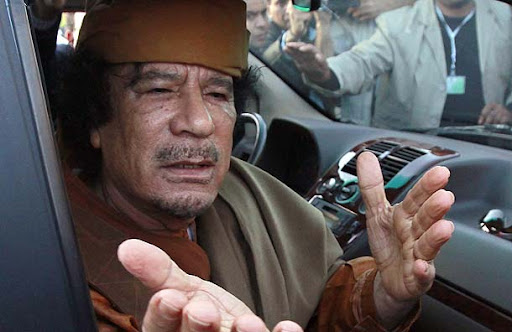 £1 million bounty was placed on Gaddafi’s head, soldiers from 22 SAS Regiment began guiding rebel soldiers after being ordered in by David Cameron.
For the first time, defence sources have confirmed that the SAS has been in Libya for several weeks, and played a key role in co-ordinating the fall of Tripoli.
With the majority of the capital now in rebel hands, the SAS soldiers, who have been dressed in Arab civilian clothing and carrying the same weapons as the rebels, have been ordered to switch their focus to the search for Gaddafi, who has been on the run since his fortified headquarters was captured on Tuesday.
Libya’s National Transitional Council (NTC) said Gaddafi was wanted “dead or alive” and promised an amnesty to any of his inner circle prepared to betray his whereabouts.
Nato still has no idea where the despot is holed up, and yesterday he taunted his opponents by claiming in a TV interview that he had secretly toured the streets of Tripoli without being spotted.
| Posted On 09:33 by El NACHO | 0 comments |
 A day after rebel fighters and thousands of ordinary Libyans stormed Col. Moammar Gadhafi's fortress compound, the strongman took to the airwaves from an unknown location to call on Libyan residents to "free Tripoli," even as the rebel-led council planned to move to Tripoli as early as Thursday.
Pro-Gadhafi regime's loyalists continue to fight on the outskirts of Libya's capital, and two big explosions were heard in Tripoli, according to news reports.
Col. Gadhafi, in a speech aired Wednesday by the local Al-Ouraba TV, sounded subdued and without his usual fiery rhetoric, the Associated Press reported.
Addressing the people in Tripoli, Col. Gadhafi asked: "Why are you letting them wreak havoc?"
Libyans poured into streets surrounding Moammar Gadhafi's fortress-like compound in Tripoli, after rebels captured it following fierce street battles against forces loyal to the longtime ruler. Jeff Grocott has the lastest on The News Hub.
The pro-Gadhafi TV channel earlier quoted the Libyan leader as saying he had left the compound in a "tactical move" after 64 North Atlantic Treaty Organization airstrikes turned it to ruble, according to news reports. He vowed martyrdom or victory in his fight against NATO aggression.
A regime spokesman, Ibrahim Moussa, said thousands of pro-Gadhafi fighters have started to enter Tripoli and will be taking action at the right time. In a televised phone interview with Al-Ouraba, Mr. Moussa said more than 6,500 volunteer fighters have entered the capital.
"We are able to fight, not for days or months, but for years... And we have put plans and alternative plans in this regards," he said.
Meanwhile, the leader of Libya's National Transition Council said the council will move its headquarters from the eastern city of Benghazi to Tripoli, though he added Libya won't be considered as liberated until the capture of Col. Gadhafi, who he speculated may be in Algeria.
"The NTC will be gradually moved to Tripoli as of the day after tomorrow," NTC leader Mustafa Abdul Jalil told France 24's Arabic channel early Wednesday.
More than 400 rebel fighters died and over 2,000 injured in the fight for Tripoli, while short of 600 Gadhafi loyalists had been captured, he said.
Mr. Jalil, who once served as a justice minister under Col. Gadhafi's regime and was among the first ex-Gadhafi officials to defect to the rebels' side, said the new Libya "will hold special relations with all countries that helped in liberating the country."
"I see Libya in the future as a Muslim, organized state and in control with peaceful and amicable ties with its neighbors," he added.
There were reports of continuing battles here, underscoring the chaos that hangs over this city of two million people. Fighters loyal to Col. Gadhafi blockaded foreign journalists in their city-center hotel Tuesday. Witnesses told Al-Arabiya television that pro-Gadhafi forces fired several Grad missiles into the capital, and west of Tripoli, loyalist forces continued to shell the towns of Zuara and Ajelat, according to residents and news reports.
The capture of Col. Gadhafi's complex, already heavily damaged by NATO airstrikes, stands as one of the rebels' highest moments in their six-month battle to topple the world's longest-tenured current ruler. But the failure to find Col. Gadhafi indicated that the rebels' mission of liberating Tripoli remains unfinished.
Ibrahim Dabbashi, who represents rebel leadership as the deputy ambassador to the United Nations, told reporters in New York that he expected Col. Gadhafi, his family members and other high officials to be hiding in private homes or in the city's underground tunnels, which he said had been built by the Libyan leader for security purposes in recent years.
Libyan oil production could ramp up much faster than initially expected as the Gadhafi regime crumbles and rebels consolidate their control over the country. Guy Chazan has the story on The News Hub from London.
Rebels had said the compound contained the largest remaining concentration of his loyalist forces, making its capture a major step toward securing Tripoli. But even though Col. Gadhafi's tenure has functionally ended, a core of loyal supporters has continued to battle in pockets throughout the city.
Rebels said they expected trouble securing two of Tripoli's most densely populated neighborhoods, the southern slums of Abu Saleem and Hadba, which have long been known as pro-Gadhafi strongholds.
U.S. military officials said that while the situation remains fluid, they believe the rebels control most of Tripoli.
In Dubai on Tuesday, U.S. and British diplomats huddled with rebel representatives to put the finishing touches on a post-Gadhafi stability plan crafted by the Libyans with Western help. Officials said the U.S. and its allies are advising the rebels on how to quickly restore basic government services and protect critical infrastructure, including oil assets.
State Department spokeswoman Victoria Nuland on Tuesday said the Obama administration was "working urgently" to release an initial $1 billion to $1.5 billion of Gadhafi-regime assets frozen by the U.S. since February. The frozen assets, totaling some $37 billion, are intended to be used to support Libyan government institutions and for reconstruction efforts, officials said. One of the officials said the U.S. hopes to release that first chunk of money later this week.
Also Tuesday, several international journalists remained pinned by pro-Gadhafi forces inside a hotel in Tripoli, where reporters have stayed throughout the conflict.
"We're very concerned about the situation at the Rixos, and we're monitoring it closely," Susan Rice, the U.S. ambassador to the U.N., told CNN. "We will do what we can from the position that we have, and from our aerial assets, to try to protect those in the Rixos Hotel and elsewhere."
The attack on the Bab al-Aziziya compound began early Tuesday, led by rebel fighting units from western Libya. Nearby streets rang with mortar, heavy machine-gun and cannon fire as rebels besieged the fortified gates to the compound that sprawls over an area the size of several square city blocks. Rebels said they used a bulldozer to breach the compound's walls.
People in Benghazi, Libya, celebrated news of the reported capture of Col. Moammar Gadhafi's son and one-time heir apparent, Seif al-Islam.
By late afternoon, the guns quieted, and black smoke billowed into the air. The deserted streets around the compound slowly filled with residents coming out to witness the sight, long unimaginable, of a liberated Gadhafi complex.
Families and young children thronged an overpass that moments before had sheltered rebel forces from incoming fire. They cheered.
Among the fighters was Fathi Mohammed, who came by boat with a group of 150 rebels from the city of Misrata, putting ashore Saturday night in the rebel-dominated Tripoli suburb of Tajoura. On Tuesday, he returned from the front line for a rest and a drink from a juice box.
"When Gadhafi's mercenaries were shelling my city months ago, I promised then I would come to Tripoli," he said. "Now I am here, and now we are finishing him off for good."
Thousands filed into the compound's leafy grounds, rifling through offices, residential buildings and an arsenal. Several hundred locals made off with assault rifles, Beretta submachine guns, AK-47s and sparkling sniper rifles, many of them apparently new and still in their hard plastic cases.
The proliferation of weapons in Libya has already raised international concerns. European Union foreign-policy chief Catherine Ashton told reporters Tuesday that the EU was committed to sending medicine, fuel and other aid to Libya, as well as easing what is shaping up as the country's biggest immediate worry, security.
"How do you ensure that so many guns and weapons are brought under control in a country without a tradition of keeping guns under control?" she said.
At the Gadhafi compound, Abdel Aziz, a Tripoli resident who was carrying two AK-47 assault rifles and a sniper rifle, made his own pledge. "I will fight for my country and turn them back into the government when we are free," he said.
Celebratory gunfire was constant and ear-piercing. Strangers embraced and kissed.
The Bedouin tent where Col. Gadhafi used to entertain visitors smoldered on the grassy lawn after rebels torched it. Groups of young men climbed up the sculpture of a clenched fist holding a U.S. warplane—a shrine constructed by Col. Gadhafi to commemorate his survival of a 1986 U.S. bombing of the compound.
Inside the Gadhafi compound late in the day, the tenuous peace was shattered. Around nightfall, the masses inside the compound made a panicked scramble for cover, when mortar rounds and gunfire rained down on the compound. Amid the chaos and confusion and volleys of celebratory fire, it wasn't clear who was firing, or from where.
"I'm not convinced," said Hamza, 23 years old. "Maybe Gadhafi's family will still come and get me."
| Posted On 19:04 by El NACHO | 0 comments |
The Late Show host made light of the situation, beginning by thanking his studio audience for being there.
He told them: "You people are more to me, honestly, than an audience - you're more like a human shield."
He added: "Backstage, I was talking to the guy from CBS. We were going through the CBS life insurance policy to see if I was covered for jihad."
Until Letterman delivered his jokes, his situation seemed no laughing matter.
Last week, a frequent contributor to a jihadist website posted the threat against him.
He urged people to "cut the tongue" of the late-night host because of a joke and gesture the comic had made about al Qaeda leaders on a show that was broadcast in June.
"A guy, a radical extremist threatened to cut my tongue out," said Letterman, who then referred to his disastrous stint hosting the Oscars in 1995.
"I wish I had a nickel for every time a guy has threatened that. I think the first time was during the Academy Awards.
"And so now State Department authorities are looking into this. But they could save themselves some trouble. Everybody knows it's Jay Leno."
| Posted On 19:02 by El NACHO | 0 comments |
Al-Megrahi was released from prison in Scotland two years ago as he fought what was then considered terminal cancer. When he returned home to Libya, he was publicly celebrated and given an audience with Colonel Muammar Gaddafi, enraging many Americans.
The bombing, which struck a flight bound for New York’s John F. Kennedy International Airport, killed 270 people, mostly Americans, including 35 students from Syracuse University in New York state.
Senator Kirsten Gillibrand of New York, a Democrat, called al-Megrahi’s appearance alongside Gaddafi last month as “another slap in the face not just for the families of the Lockerbie victims, but for all Americans and all nations of the world who are committed to bringing terrorists to justice.
“The transitional government should immediately seek justice and hold this terrorist accountable by sending him back to prison. If we’re ever going to win the fight against international terrorism, the rule of law must hold strong.”
Senator Chuck Schumer, another New York Democrat, said that a new Libyan government “should seek to undo the injustice of al-Megrahi’s release by returning him to the jail cell where he belongs”.
| Posted On 19:00 by El NACHO | 0 comments |
The Guardian has learned that a number of serving British special forces soldiers, as well as former SAS troopers, are advising and training rebel forces, although their presence is officially denied.
The Guardian has previously reported the presence of former British special forces troops, now employed by private security companies and funded by a number of sources, including Qatar. They have been joined by a number of serving SAS soldiers.
They have been acting as forward air controllers – directing pilots to targets – and communicating with Nato operational commanders. They have also been advising rebels on tactics, a task they have not found easy.
For the SAS it is a return to old stamping grounds. In one of their first successful missions in the second world war, they attacked airfields in Libya, destroying 60 aircraft. SAS battle honours include Tobruk in 1941 and a raid on Benghazi in 1942.
They returned to Libya in February this year, even before the UN mandate urging states to protect civilians from Gaddafi's forces. Shortly afterwards, a group of SAS soldiers were seized, though quickly released, by nervous rebels south of Benghazi when their Chinook helicopter landed two MI6 officers with communications equipment.
SAS soldiers later advised Misrata-based rebel forces who secured the port city and helped to pass on details of the locations of Gaddafi's forces to British commanders in the UK and the Naples headquarters of Canadian commander of Nato forces, Lt Gen Charles Bouchard.
In what is hoped to be the endgame in the Libyan conflict and the fight to oust Gaddafi, a number of SAS soldiers are now advising the rebels as they storm the capital, Tripoli.
France is understood to have deployed special forces in Libya and Qatari and Jordanian special forces are believed to have also played a role.
| Posted On 19:31 by El NACHO | 0 comments |
 Anders Brehing Breivik, the man accused of the murder of at least 91 Norwegians in a twin bomb and gun massacre, boasted online about his discussions with the far right English Defence League and other anti-Islamic European organisations.
The Norwegian prime minister, Jens Stoltenberg, said Norwegian officials were working with foreign intelligence agencies to see if there was any international involvement in the slaughter. "We have running contact with other countries' intelligence services," he said.
Breivik was arrested on Utøya island where he shot and killed at least 84 people, mostly teenagers, at a youth summer camp for supporters of Norway's Labour Party after bombing Oslo's government district just hours before.Dressed as a policeman, he ordered the teenagers to gather round him before opening fire on them. Survivors described how dozens of people were mown down. Edvard Fornes, 16, described how the gunman told the youths, "Don't be shy," and, "Come and play with me," before executing them. "There were two kids lying, hiding, in a ditch saying, 'please, please don't shoot us,' and he shot them."
Another youth, Ida Knudsen, 16, said she had been in a group of 100 who had initially ran from the killer, but that was reduced to around 60 as the gunman pursued them. Eventually she was one of 12 who climbed into a boat and escaped.
With the entire island a crime scene, officers were still combing the shoreline on Saturday and boats were searching the water for more bodies amid fears the toll could rise further. The police were continuing to investigate whether there had been a second gunman on the island.
The disclosure of Breivik's claimed links with other far right organisations came as details emerged about the rightwing Christian fundamentalist and freemason behind Norway's worst post-war act of violence.
It was revealed that the 32-year-old former member of the country's conservative Progress Party – who had become ever more extreme in his hatred of Muslims, left wingers and the country's political establishment – had ordered six tonnes of fertiliser in May to be used in the bombing. While police continued to interrogate Breivik, who was charged with the mass killings, evidence of his increasingly far right world view emerged from an article he had posted on several Scandinavian websites, including Nordisk – a site frequented by neo-Nazis, far right radicals and Islamophobes since 2009.
The Norwegian daily VG quoted one of Breivik's friends saying that he had become a rightwing extremist in his late 20s and was now a strong opponent of multi-culturalism, expressing strong nationalistic views in online debates.
Breivik had talked admiringly about conversations he had had with unnamed English Defence League members and the organisation Stop the Islamification of Europe over the success of provocative street actions leading to violence.
"I have on some occasions had discussions with SIOE and EDL and recommended them to use certain strategies," he wrote two years ago.
"The tactics of the EDL are now to 'lure' an overreaction from the Jihad Youth/Extreme-Marxists, something they have succeeded in doing several times already." Contacted about the allegation by email by last night the EDL had not answered.
The latest disclosures came as the Norwegian prime minister Jens Stoltenberg flew by helicopter to a hotel in the town of Sundvollen – close to the island of Utøya – where many survivors were taken and where relatives converged to reunite with their loved ones or to identify their dead.
"A whole world is thinking of them," Stoltenberg said, his voice cracking with emotion. He said the twin attacks made Friday the deadliest day in peacetime Norway. "This is beyond comprehension. It's a nightmare. It's a nightmare for those who have been killed, for their mothers and fathers, family and friends," he said.
Buildings around the capital lowered their flags to half-staff. People streamed to Oslo cathedral to light candles and lay flowers; outside, mourners began building a makeshift altar from dug-up cobblestones. On Saturday the Queen wrote to Norway's King Harald to offer her condolences and express her shock and sadness.
Breivik's Facebook page was blocked, but a cached version describes a conservative Christian from Oslo. The profile veers between references to lofty political philosophers and gory popular films, television shows and video games. The account appears to have been set up on 17 July. The site lists no "friends" or social connections.
| Posted On 20:49 by El NACHO | 0 comments |
British troops were involved in the operation to arrest the UK couple in Afghanistan
The couple were reportedly in the war-torn country in an effort to link up with the Taliban or al Qaeda to learn bomb-making skills.
Limited details of their arrest emerged on Thursday with authorities only confirming two British nationals had been detained.
The pair are thought to be in their late 20s and are known to Britain's security intelligence agency MI5.
They are reportedly of Afghan origin and are understood to have dual nationality.
They were taken into custody after British troops, joined by members of the Afghan intelligence service, swooped on their room at the International Trade Centre hotel in Herat, near the Iranian border, last week.
The Daily Telegraph reports that the couple had been under surveillance as part of a joint operation involving British police and Afghan security intelligence agents.
The couple were arrested at a hotel in Herat in western Afghanistan
The newspaper also said undercover officers raided several hotels in the Herat area, showing people pictures of the suspects and asking of their whereabouts, before the man and woman were arrested.
The Ministry of Defence confirmed that two British passport-holders were being held.
It said in a statement: "The individuals, a male and a female, are currently being held in a secure facility in Kandahar for questioning.
"No further information will be released at this stage."
Officers at MI5's London headquarters are helping to investigate
Nato forces in Afghanistan normally hold suspects for a maximum of four days before releasing them or handing them over to the Afghan authorities.
But a Foreign Office spokeswoman said this has been extended.
Clive Stafford Smith, from the legal charity Reprieve, which campaigns for prisoners' rights, has warned they could be tortured or get the death penalty if they are transferred to Afghan custody.
He said he hopes to launch a legal battle to have them repatriated to Britain.
An MoD spokesman added that all detention operations were conducted in "accordance with international law and strict policy frameworks".
Mr Cameron says British troops numbers in Afghanistan will be cut
Britain has about 9,500 troops in Afghanistan as part of international forces fighting the Taliban insurgency.
Prime Minister David Cameron announced earlier this month that Britain would withdraw 500 troops by the end of next year, but would keep soldiers there in a training role until at least 2023.
His announcement came a fortnight after President Barack Obama announced a big drawdown of US forces in the war-torn country.
| Posted On 20:45 by El NACHO | 0 comments |
The last fugitive wanted by the United Nations war crimes tribunal was handed over by Serbian authorities on Friday, ending a tense and drawn-out custody battle over Balkan war crimes suspects that started more than 16 years ago.
Goran Hadzic, 52, entered the high-security prison compound near The Hague in The Netherlands on Friday afternoon. He had been on the run for seven years, hiding in Serbia and other countries, including Russia, according to his lawyers.
“He used another name,” said Radoslav Marenkovic, one of the lawyers, “but he had regular Serbian identity papers.” The tribunal prosecutor, Serge Brammertz, said he hoped that Serbia would explain how Mr. Hadzic had eluded justice for so long.
While calling the arrival of the last fugitive “a milestone” for the tribunal, Mr. Brammertz reminded Serbia that he still wanted access to more of its wartime archives and expected the government’s help in providing access to witnesses.
Before his flight to The Hague, Mr. Hadzic was allowed to visit his ailing mother in the town of Novi Sad and to stop briefly at the tomb of his father in a nearby town.
Mr. Hadzic is scheduled appear Monday in court, where will be read the charges he faces, including a long list of atrocities that took place in Croatia in the early 1990s when Serbs seized almost one-third of Croatian territory known as Krajina and drove out the non-Serb population, torturing and killing many. Mr. Hadzic’s indictment holds him accountable for much of the violence as the president of the short-lived Republic of Serbian Krajina, even though his orders, money and weapons came from the government of Serbia. Croatia took back the land in 1995.
New questions arose Friday over the actions surrounding Mr. Hadzic’s arrest. On Wednesday, a Serbian prosecutor said that Mr. Hadzic had been caught because, from his hiding place, he tried to sell a stolen painting by the Italian modernist Modigliani, but others have since contradicted this. Mr. Marenkovic, the lawyer, dismissed the prosecutors’ statement as “completely false,” saying that Mr. Hadzic “did not try to sell a Modigliani or any other painting.”
Fake and stolen artworks have circulated in recent years in Serbia and other parts of the former Yugoslavia, according to experts. But Charles Hill, a retired Scotland Yard detective and an expert on recovering stolen art, said that stolen works found in Serbia had usually been fakes.
“There are some exceptions, but usually they are fakes.” Mr. Hill said. “That’s been my experience.”
| Posted On 20:43 by El NACHO | 0 comments |
 The development renews pressure on the prime minister over his judgment in hiring the former News of the World editor and represents the third criminal investigation Coulson faces, adding to allegations that he knew of phone hacking while in charge of the tabloid and authorised bribes to police officers.
Strathclyde detectives confirmed that they had opened a perjury inquiry centred on evidence Coulson gave in court last year that led to a man being jailed.
Coulson was a major witness in a trial involving Tommy Sheridan, the former MSP who was accused of lying in court when winning a libel action against the News of the World. Coulson had been the editor of the Sunday tabloid when it ran a story accusing Sheridan of being an adulterer who visited swingers' clubs.
Sources say police will examine Coulson's denial of any knowledge of phone hacking and payments to police officers at the Sheridan trial against the evidence held by the Scotland Yard investigation.
At the trial Coulson also denied knowing that the paper paid corrupt police officers for tip-offs, which contradicts recent disclosures that News International has uncovered emails showing payments were made to the police during his editorship.
Coulson, who was called as a witness in December 2010, told the court that he had no knowledge of illegal activities by reporters while he was editor of the newspaper.
He also claimed: "I don't accept there was a culture of phone hacking at the News of the World."
Sheridan was jailed for three years in January after being found guilty of perjury during his 2006 defamation action against the NoW. He had successfully sued the newspaper over its claims.
Also giving testimony alongside Coulson were Bob Bird, the News of the World's Scottish editor, and Douglas Wight, the Scottish edition's former news editor.
Bird denied being part of a "culture of phone tapping" and Wight, who is now the paper's books editor, told the court he was not aware of any payment for illegal activities.
Strathclyde police's assistant chief constable, George Hamilton, said: "Following our discussions with the crown, we have now been instructed to carry out a full investigation into allegations that witnesses gave perjured evidence in the trial of Tommy Sheridan and into alleged breaches of data protection and phone hacking.
"We will also be looking to see if we can uncover any evidence of corruption in the police service or any other organisation related to these inquiries.
"However, I must stress that no specific allegations regarding corruption have been presented to us at this time.
"We will be working with the Metropolitan police and with the other Scottish forces as we progress with the investigation.
"I have put in place a structure that will allow us to work effectively together, but also to ensure that any member of the public who has a concern regarding the safety and security of their private data and information is able to register that concern and to have it properly investigated.
"By its very nature, this investigation will require us to allocate varying levels of resources to it. There is a huge amount of material to consider and, potentially, a large number of people to contact.
"This will mean that the investigation is likely to be a lengthy one. However, you have my absolute assurance that it will be a thorough one. We will do everything we can to find out the facts and to report all examples of wrongdoing."
Sheridan's lawyer, Aamer Anwar, said: "Over two weeks ago we provided a detailed dossier of allegations of perjury, phone hacking and breach of data to Strathclyde police and called for a robust investigation.
"Over £2m was spent by the police on investigating Mr and Mrs Sheridan and we were told it was in the public interest. I expect now to see a similar ruthlessness and determination in dealing with the News of the World."
A News International spokeswoman said: "We can confirm that we have been contacted by police on this matter. We can't say anything else."
Earlier this month it emerged that Coulson had hired one of Scotland's top QCs, Paul McBride.
| Posted On 20:41 by El NACHO | 0 comments |
A memo written in 2009, describes the country’s security service as “in over its head” and adds “it simply cannot keep up.”
Separate cables state that the country felt “immune” from terrorism and that groups such as Al Qaeda were “not a direct threat”.
One memo describes how US authorities had to “press” their Norwegian counterparts to take terrorism seriously and says there was a feeling “that terrorism happens elsewhere, not in peaceful Norway.”
Talking about an attempt by the Police Security Service (PST) to track one particular suspected Al Qaeda terror cell, a cable written by the US Ambassador to Norway, Barry White, describes investigators as “committed, competent and co-operative, generally”.
But he goes on to describe how they refused the help of the UK authorities to put surveillance on a potential suspect and adds: “Not only will they not put their own resources on him…but they also just turned down the visiting UK intel service’s offer of two twelve-person surveillance teams.”
| Posted On 08:03 by El NACHO | 0 comments |
It is believed the blast occurred in the early hours of this morning in an area where munitions seized from a vessel heading to Syria from Iran in 2009 had been dumped.
"There are a number of dead which we cannot confirm yet," a spokesperson for the Ministry of Defence said.
The intensity of the blast caused damage to neighbouring communities and windows and doors of beachside restaurants were blown out.
Police spokesman Michalis Katsounotos said that a fire at a nearby power station had been contained.
A witness told Reuters: "The place looks like it was hit by a massive bomb."
| Posted On 19:36 by El NACHO | 0 comments |
Last Tuesday evening, the Taliban staged one of their most brazen attacks to date in the Afghan capital.
For nearly four hours, nine heavily armed suicide bombers invaded the Intercontinental hotel in the middle of Kabul, battling security forces and targeting foreign hotel guests.
After NATO helicopters and Special Forces operatives were deployed, the last of the wounded Taliban detonated his explosive vest, taking his own life and ending the bloody battle.
It was estimated that 11 civilians were killed during the attack and several dozen more wounded, while all nine insurgents achieved their aim of dying in battle.
The Intercontinental has long been a prominent landmark in Kabul as it is perched on a steep hill and visible from nearly everywhere in the city.
During my many trips to Kabul, I have never stayed at the Intercontinental but I have visited colleagues there on several occasions. What had once been the most luxurious hotel in Afghanistan still showed glimpses of its former glory but three decades of war have left scars too deep to conceal. Nevertheless, many foreigners choose to reside there for the fact that, until the June 29 attack, the Intercontinental gave the impression of being a safe fortress.
Ascending to the hilltop hotel is a solitary road protected by a number of fortified checkpoints manned by Afghan police and security forces. Knowing the lay of this land makes it difficult to understand how nine, heavily armed, suicide bombers were able to penetrate that many layers of security before entering the hotel — unless there was collusion with the guards.
NATO and the Karzai government were quick to point out that the relatively low loss of civilian life and the fact that the security response resulted in the death of all attackers tallied up to a Taliban defeat. However, nothing could be further from the truth.
The goal of the Taliban was to stage a symbolic demonstration of their presence in the middle of Kabul, despite the efforts of Afghan and NATO forces combined. In this, they were extremely successful.
For nearly four hours, it would have been impossible for Kabul residents to be unaware that a battle was raging at the Intercontinental. The flashes, booms and sounds of helicopter gunships emanating from that hilltop landmark certainly made it clear that the Taliban can disrupt the security situation in Afghanistan wherever they choose.
This of course flies in the face of the recent pronouncement by U.S. President Barack Obama in which he announced the start of American troop reduction in Afghanistan. Obama’s rationale was that the recent surge of U.S. troops had succeeded in turning the tide in NATO’s favour.
However, as evidenced by the Intercontinental attack and the continued spike in NATO casualties, the surge succeeded only in intensifying the conflict. The Intercontinental attack also highlighted the folly of turning over increased responsibility to the ill-trained Afghan security forces. Once again, at a crucial juncture, Afghan security disappeared prior to this attack.
After nearly a decade of training, equipping and funding the Afghan army and police, we have yet to buy their loyalty — and we never will.
They are paid by foreigners to wear western-style uniforms in order to prop up a hated and corrupt regime that failed to win a democratic mandate following the farcical 2009 elections. They will continue to pocket as much NATO cash as they can.
And it should be noted that Afghan soldiers make a relatively lucrative salary that is three times that of Afghan teachers. Once the U.S. and NATO countries complete the projected withdrawal of all troops by 2014, the Afghan security forces will quickly dissolve back into the private militias of warlords.
One has to hope they have enough remaining loyalty in the rental agreement to secure the airfields until the last of NATO’s planes are airborne.
| Posted On 19:34 by El NACHO | 0 comments |
Britain's Defense Ministry has confirmed that a British soldier who went missing in southern Afghanistan has been found shot dead.
The ministry said Monday the soldier went missing from his base in southern Afghanistan and that he was from The Highlanders, 4th Battalion The Royal Regiment of Scotland. The statement did not provide details of the circumstances in which he was found.
It said that his family has been informed.
International forces hunted for him earlier Monday amid insurgent claims that he had been captured and killed hours before the arrival of Britain's prime minister to Afghanista. The Taliban say insurgents captured the soldier during a firefight with NATO troops and that he died in the crossfire.
| Posted On 19:33 by El NACHO | 0 comments |
U.S. military leaders are working to replace some of the exiting American conventional forces from Afghanistan with a "mini-surge" of U.S. Special Forces, a measure to soothe commanders’ fears that the withdrawal of troops might put at risk military gains, according to the Times out of Australia.
Military sources told The Times that 16 special operations personnel are considered to be worth the equivalent of 100 conventional troops.
In June, President Obama announced plans to withdraw 10,000 U.S. troops from Afghanistan by the end of the year. The remainder of the surge troops, about 23,000, would be withdrawn in 2012, leaving about 70,000 troops in Afghanistan until 2014.
Defense analysts have said of late that the reduction of conventional troops likely will place a heavier burden on clandestine units, such as SEALs, and Army Rangers and Green Berets.
The Times reports there are more than 7,000 U.S. Special Forces in Afghanistan and about 3,000 in Iraq, with many of the latter expected to be moved to Afghanistan.


