Frontline Blog

Saturday, 23 July 2011

Utøya gunman boasted of links to UK far right

Posted On 19:31 by El NACHO 0 comments

Anders Brehing Breivik, the man accused of the murder of at least 91 Norwegians in a twin bomb and gun massacre, boasted online about his discussions with the far right English Defence League and other anti-Islamic European organisations.

The Norwegian prime minister, Jens Stoltenberg, said Norwegian officials were working with foreign intelligence agencies to see if there was any international involvement in the slaughter. "We have running contact with other countries' intelligence services," he said.

Breivik was arrested on Utøya island where he shot and killed at least 84 people, mostly teenagers, at a youth summer camp for supporters of Norway's Labour Party after bombing Oslo's government district just hours before.Dressed as a policeman, he ordered the teenagers to gather round him before opening fire on them. Survivors described how dozens of people were mown down. Edvard Fornes, 16, described how the gunman told the youths, "Don't be shy," and, "Come and play with me," before executing them. "There were two kids lying, hiding, in a ditch saying, 'please, please don't shoot us,' and he shot them."

Another youth, Ida Knudsen, 16, said she had been in a group of 100 who had initially ran from the killer, but that was reduced to around 60 as the gunman pursued them. Eventually she was one of 12 who climbed into a boat and escaped.

With the entire island a crime scene, officers were still combing the shoreline on Saturday and boats were searching the water for more bodies amid fears the toll could rise further. The police were continuing to investigate whether there had been a second gunman on the island.

The disclosure of Breivik's claimed links with other far right organisations came as details emerged about the rightwing Christian fundamentalist and freemason behind Norway's worst post-war act of violence.

It was revealed that the 32-year-old former member of the country's conservative Progress Party – who had become ever more extreme in his hatred of Muslims, left wingers and the country's political establishment – had ordered six tonnes of fertiliser in May to be used in the bombing. While police continued to interrogate Breivik, who was charged with the mass killings, evidence of his increasingly far right world view emerged from an article he had posted on several Scandinavian websites, including Nordisk – a site frequented by neo-Nazis, far right radicals and Islamophobes since 2009.

The Norwegian daily VG quoted one of Breivik's friends saying that he had become a rightwing extremist in his late 20s and was now a strong opponent of multi-culturalism, expressing strong nationalistic views in online debates.

Breivik had talked admiringly about conversations he had had with unnamed English Defence League members and the organisation Stop the Islamification of Europe over the success of provocative street actions leading to violence.

"I have on some occasions had discussions with SIOE and EDL and recommended them to use certain strategies," he wrote two years ago.

"The tactics of the EDL are now to 'lure' an overreaction from the Jihad Youth/Extreme-Marxists, something they have succeeded in doing several times already." Contacted about the allegation by email by last night the EDL had not answered.

The latest disclosures came as the Norwegian prime minister Jens Stoltenberg flew by helicopter to a hotel in the town of Sundvollen – close to the island of Utøya – where many survivors were taken and where relatives converged to reunite with their loved ones or to identify their dead.

"A whole world is thinking of them," Stoltenberg said, his voice cracking with emotion. He said the twin attacks made Friday the deadliest day in peacetime Norway. "This is beyond comprehension. It's a nightmare. It's a nightmare for those who have been killed, for their mothers and fathers, family and friends," he said.

Buildings around the capital lowered their flags to half-staff. People streamed to Oslo cathedral to light candles and lay flowers; outside, mourners began building a makeshift altar from dug-up cobblestones. On Saturday the Queen wrote to Norway's King Harald to offer her condolences and express her shock and sadness.

Breivik's Facebook page was blocked, but a cached version describes a conservative Christian from Oslo. The profile veers between references to lofty political philosophers and gory popular films, television shows and video games. The account appears to have been set up on 17 July. The site lists no "friends" or social connections.


Friday, 22 July 2011

British man and woman suspected of plotting UK terrorist attacks are still being quizzed a week after they were arrested in Afghanistan.

Posted On 20:49 by El NACHO 0 comments


British troops were involved in the operation to arrest the UK couple in Afghanistan
The couple were reportedly in the war-torn country in an effort to link up with the Taliban or al Qaeda to learn bomb-making skills.
Limited details of their arrest emerged on Thursday with authorities only confirming two British nationals had been detained.
The pair are thought to be in their late 20s and are known to Britain's security intelligence agency MI5.
They are reportedly of Afghan origin and are understood to have dual nationality.
They were taken into custody after British troops, joined by members of the Afghan intelligence service, swooped on their room at the International Trade Centre hotel in Herat, near the Iranian border, last week.
The Daily Telegraph reports that the couple had been under surveillance as part of a joint operation involving British police and Afghan security intelligence agents.

The couple were arrested at a hotel in Herat in western Afghanistan
The newspaper also said undercover officers raided several hotels in the Herat area, showing people pictures of the suspects and asking of their whereabouts, before the man and woman were arrested.
The Ministry of Defence confirmed that two British passport-holders were being held.
It said in a statement: "The individuals, a male and a female, are currently being held in a secure facility in Kandahar for questioning.
"No further information will be released at this stage."

Officers at MI5's London headquarters are helping to investigate
Nato forces in Afghanistan normally hold suspects for a maximum of four days before releasing them or handing them over to the Afghan authorities.
But a Foreign Office spokeswoman said this has been extended.
Clive Stafford Smith, from the legal charity Reprieve, which campaigns for prisoners' rights, has warned they could be tortured or get the death penalty if they are transferred to Afghan custody.
He said he hopes to launch a legal battle to have them repatriated to Britain.
An MoD spokesman added that all detention operations were conducted in "accordance with international law and strict policy frameworks".

Mr Cameron says British troops numbers in Afghanistan will be cut
Britain has about 9,500 troops in Afghanistan as part of international forces fighting the Taliban insurgency.
Prime Minister David Cameron announced earlier this month that Britain would withdraw 500 troops by the end of next year, but would keep soldiers there in a training role until at least 2023.
His announcement came a fortnight after President Barack Obama announced a big drawdown of US forces in the war-torn country.


Last Serbian War Crimes Fugitive Handed Over to Tribunal

Posted On 20:45 by El NACHO 0 comments

The last fugitive wanted by the United Nations war crimes tribunal was handed over by Serbian authorities on Friday, ending a tense and drawn-out custody battle over Balkan war crimes suspects that started more than 16 years ago.

Goran Hadzic, 52, entered the high-security prison compound near The Hague in The Netherlands on Friday afternoon. He had been on the run for seven years, hiding in Serbia and other countries, including Russia, according to his lawyers.

“He used another name,” said Radoslav Marenkovic, one of the lawyers, “but he had regular Serbian identity papers.” The tribunal prosecutor, Serge Brammertz, said he hoped that Serbia would explain how Mr. Hadzic had eluded justice for so long.

While calling the arrival of the last fugitive “a milestone” for the tribunal, Mr. Brammertz reminded Serbia that he still wanted access to more of its wartime archives and expected the government’s help in providing access to witnesses.

Before his flight to The Hague, Mr. Hadzic was allowed to visit his ailing mother in the town of Novi Sad and to stop briefly at the tomb of his father in a nearby town.

Mr. Hadzic is scheduled appear Monday in court, where will be read the charges he faces, including a long list of atrocities that took place in Croatia in the early 1990s when Serbs seized almost one-third of Croatian territory known as Krajina and drove out the non-Serb population, torturing and killing many. Mr. Hadzic’s indictment holds him accountable for much of the violence as the president of the short-lived Republic of Serbian Krajina, even though his orders, money and weapons came from the government of Serbia. Croatia took back the land in 1995.

New questions arose Friday over the actions surrounding Mr. Hadzic’s arrest. On Wednesday, a Serbian prosecutor said that Mr. Hadzic had been caught because, from his hiding place, he tried to sell a stolen painting by the Italian modernist Modigliani, but others have since contradicted this. Mr. Marenkovic, the lawyer, dismissed the prosecutors’ statement as “completely false,” saying that Mr. Hadzic “did not try to sell a Modigliani or any other painting.”

Fake and stolen artworks have circulated in recent years in Serbia and other parts of the former Yugoslavia, according to experts. But Charles Hill, a retired Scotland Yard detective and an expert on recovering stolen art, said that stolen works found in Serbia had usually been fakes.

“There are some exceptions, but usually they are fakes.” Mr. Hill said. “That’s been my experience.”


Andy Coulson, the prime minister's former director of communications, is being investigated by police for allegedly committing perjury while working for David Cameron in Downing Street.

Posted On 20:43 by El NACHO 0 comments


The development renews pressure on the prime minister over his judgment in hiring the former News of the World editor and represents the third criminal investigation Coulson faces, adding to allegations that he knew of phone hacking while in charge of the tabloid and authorised bribes to police officers.
Strathclyde detectives confirmed that they had opened a perjury inquiry centred on evidence Coulson gave in court last year that led to a man being jailed.

Coulson was a major witness in a trial involving Tommy Sheridan, the former MSP who was accused of lying in court when winning a libel action against the News of the World. Coulson had been the editor of the Sunday tabloid when it ran a story accusing Sheridan of being an adulterer who visited swingers' clubs.

Sources say police will examine Coulson's denial of any knowledge of phone hacking and payments to police officers at the Sheridan trial against the evidence held by the Scotland Yard investigation.

At the trial Coulson also denied knowing that the paper paid corrupt police officers for tip-offs, which contradicts recent disclosures that News International has uncovered emails showing payments were made to the police during his editorship.

Coulson, who was called as a witness in December 2010, told the court that he had no knowledge of illegal activities by reporters while he was editor of the newspaper.

He also claimed: "I don't accept there was a culture of phone hacking at the News of the World."

Sheridan was jailed for three years in January after being found guilty of perjury during his 2006 defamation action against the NoW. He had successfully sued the newspaper over its claims.

Also giving testimony alongside Coulson were Bob Bird, the News of the World's Scottish editor, and Douglas Wight, the Scottish edition's former news editor.

Bird denied being part of a "culture of phone tapping" and Wight, who is now the paper's books editor, told the court he was not aware of any payment for illegal activities.

Strathclyde police's assistant chief constable, George Hamilton, said: "Following our discussions with the crown, we have now been instructed to carry out a full investigation into allegations that witnesses gave perjured evidence in the trial of Tommy Sheridan and into alleged breaches of data protection and phone hacking.

"We will also be looking to see if we can uncover any evidence of corruption in the police service or any other organisation related to these inquiries.

"However, I must stress that no specific allegations regarding corruption have been presented to us at this time.

"We will be working with the Metropolitan police and with the other Scottish forces as we progress with the investigation.

"I have put in place a structure that will allow us to work effectively together, but also to ensure that any member of the public who has a concern regarding the safety and security of their private data and information is able to register that concern and to have it properly investigated.

"By its very nature, this investigation will require us to allocate varying levels of resources to it. There is a huge amount of material to consider and, potentially, a large number of people to contact.

"This will mean that the investigation is likely to be a lengthy one. However, you have my absolute assurance that it will be a thorough one. We will do everything we can to find out the facts and to report all examples of wrongdoing."

Sheridan's lawyer, Aamer Anwar, said: "Over two weeks ago we provided a detailed dossier of allegations of perjury, phone hacking and breach of data to Strathclyde police and called for a robust investigation.

"Over £2m was spent by the police on investigating Mr and Mrs Sheridan and we were told it was in the public interest. I expect now to see a similar ruthlessness and determination in dealing with the News of the World."

A News International spokeswoman said: "We can confirm that we have been contacted by police on this matter. We can't say anything else."

Earlier this month it emerged that Coulson had hired one of Scotland's top QCs, Paul McBride.


Norway’s intelligence service had previously been criticised for its failure to keep track of suspected terror cells

Posted On 20:41 by El NACHO 0 comments

A memo written in 2009, describes the country’s security service as “in over its head” and adds “it simply cannot keep up.”
Separate cables state that the country felt “immune” from terrorism and that groups such as Al Qaeda were “not a direct threat”.
One memo describes how US authorities had to “press” their Norwegian counterparts to take terrorism seriously and says there was a feeling “that terrorism happens elsewhere, not in peaceful Norway.”
Talking about an attempt by the Police Security Service (PST) to track one particular suspected Al Qaeda terror cell, a cable written by the US Ambassador to Norway, Barry White, describes investigators as “committed, competent and co-operative, generally”.
But he goes on to describe how they refused the help of the UK authorities to put surveillance on a potential suspect and adds: “Not only will they not put their own resources on him…but they also just turned down the visiting UK intel service’s offer of two twelve-person surveillance teams.”


Monday, 11 July 2011

dozens of people have been injured at the Evangelos Florakis base in Zygi, between the southern coastal cities of Limassol and Larnaca.

Posted On 08:03 by El NACHO 0 comments


It is believed the blast occurred in the early hours of this morning in an area where munitions seized from a vessel heading to Syria from Iran in 2009 had been dumped.
"There are a number of dead which we cannot confirm yet," a spokesperson for the Ministry of Defence said.
The intensity of the blast caused damage to neighbouring communities and windows and doors of beachside restaurants were blown out.
Police spokesman Michalis Katsounotos said that a fire at a nearby power station had been contained.
A witness told Reuters: "The place looks like it was hit by a massive bomb."


Monday, 4 July 2011

Hotel attack proves Taliban can strike anywhere in Afghanistan

Posted On 19:36 by El NACHO 0 comments

Last Tuesday evening, the Taliban staged one of their most brazen attacks to date in the Afghan capital.

For nearly four hours, nine heavily armed suicide bombers invaded the Intercontinental hotel in the middle of Kabul, battling security forces and targeting foreign hotel guests.

After NATO helicopters and Special Forces operatives were deployed, the last of the wounded Taliban detonated his explosive vest, taking his own life and ending the bloody battle.

It was estimated that 11 civilians were killed during the attack and several dozen more wounded, while all nine insurgents achieved their aim of dying in battle.

The Intercontinental has long been a prominent landmark in Kabul as it is perched on a steep hill and visible from nearly everywhere in the city.

During my many trips to Kabul, I have never stayed at the Intercontinental but I have visited colleagues there on several occasions. What had once been the most luxurious hotel in Afghanistan still showed glimpses of its former glory but three decades of war have left scars too deep to conceal. Nevertheless, many foreigners choose to reside there for the fact that, until the June 29 attack, the Intercontinental gave the impression of being a safe fortress.

Ascending to the hilltop hotel is a solitary road protected by a number of fortified checkpoints manned by Afghan police and security forces. Knowing the lay of this land makes it difficult to understand how nine, heavily armed, suicide bombers were able to penetrate that many layers of security before entering the hotel — unless there was collusion with the guards.

NATO and the Karzai government were quick to point out that the relatively low loss of civilian life and the fact that the security response resulted in the death of all attackers tallied up to a Taliban defeat. However, nothing could be further from the truth.

The goal of the Taliban was to stage a symbolic demonstration of their presence in the middle of Kabul, despite the efforts of Afghan and NATO forces combined. In this, they were extremely successful.

For nearly four hours, it would have been impossible for Kabul residents to be unaware that a battle was raging at the Intercontinental. The flashes, booms and sounds of helicopter gunships emanating from that hilltop landmark certainly made it clear that the Taliban can disrupt the security situation in Afghanistan wherever they choose.

This of course flies in the face of the recent pronouncement by U.S. President Barack Obama in which he announced the start of American troop reduction in Afghanistan. Obama’s rationale was that the recent surge of U.S. troops had succeeded in turning the tide in NATO’s favour.

However, as evidenced by the Intercontinental attack and the continued spike in NATO casualties, the surge succeeded only in intensifying the conflict. The Intercontinental attack also highlighted the folly of turning over increased responsibility to the ill-trained Afghan security forces. Once again, at a crucial juncture, Afghan security disappeared prior to this attack.

After nearly a decade of training, equipping and funding the Afghan army and police, we have yet to buy their loyalty — and we never will.

They are paid by foreigners to wear western-style uniforms in order to prop up a hated and corrupt regime that failed to win a democratic mandate following the farcical 2009 elections. They will continue to pocket as much NATO cash as they can.

And it should be noted that Afghan soldiers make a relatively lucrative salary that is three times that of Afghan teachers. Once the U.S. and NATO countries complete the projected withdrawal of all troops by 2014, the Afghan security forces will quickly dissolve back into the private militias of warlords.

One has to hope they have enough remaining loyalty in the rental agreement to secure the airfields until the last of NATO’s planes are airborne.


Britain's Defense Ministry has confirmed that a British soldier who went missing in southern Afghanistan has been found shot dead.

Posted On 19:34 by El NACHO 0 comments

Britain's Defense Ministry has confirmed that a British soldier who went missing in southern Afghanistan has been found shot dead.

The ministry said Monday the soldier went missing from his base in southern Afghanistan and that he was from The Highlanders, 4th Battalion The Royal Regiment of Scotland. The statement did not provide details of the circumstances in which he was found.

It said that his family has been informed.

International forces hunted for him earlier Monday amid insurgent claims that he had been captured and killed hours before the arrival of Britain's prime minister to Afghanista. The Taliban say insurgents captured the soldier during a firefight with NATO troops and that he died in the crossfire.


U.S. military leaders are working to replace some of the exiting American conventional forces from Afghanistan with a "mini-surge" of U.S. Special Forces

Posted On 19:33 by El NACHO 0 comments

U.S. military leaders are working to replace some of the exiting American conventional forces from Afghanistan with a "mini-surge" of U.S. Special Forces, a measure to soothe commanders’ fears that the withdrawal of troops might put at risk military gains, according to the Times out of Australia.

Military sources told The Times that 16 special operations personnel are considered to be worth the equivalent of 100 conventional troops.

In June, President Obama announced plans to withdraw 10,000 U.S. troops from Afghanistan by the end of the year. The remainder of the surge troops, about 23,000, would be withdrawn in 2012, leaving about 70,000 troops in Afghanistan until 2014.

Defense analysts have said of late that the reduction of conventional troops likely will place a heavier burden on clandestine units, such as SEALs, and Army Rangers and Green Berets.

The Times reports there are more than 7,000 U.S. Special Forces in Afghanistan and about 3,000 in Iraq, with many of the latter expected to be moved to Afghanistan.


Wednesday, 29 June 2011

The French government has admitted it has supplied weapons to Libyan rebels fighting Colonel Gaddafi's forces not far from the capital Tripoli.

Posted On 23:24 by El NACHO 0 comments


A leading French newspaper is reporting the arms drops were made without the knowledge of France's NATO allies.

Despite media reports that the weapons included rocket launchers and anti-tank missiles, the French military says the supplies only consisted of rifles and ammunition.

A spokesman for the French general staff said the air drops in the Nafusa mountains began with humanitarian aid, including food, water and medical supplies.

But he said guns were also supplied for the self-defence of the mainly Berber fighters, who pushed to within 65 kilometres of Tripoli.

The supply of arms, however limited, is likely to reignite debate over the remit of NATO, which was authorised by the United Nations to protect Libyan civilians.

One UN diplomat said "a reading of the text of the UN resolutions on Libya does not prohibit the air drop of arms over Libya to protect civilians."

In London, British foreign minister William Hague said the rebel leadership based in the eastern city of Benghazi, had received the first $US100 million of international funding in the past week.

The rebels complained earlier this month they were running out of money and had not yet received any of the roughly $US1 billion promised by international donors.


Several suicide bombers and four gunmen attacked a large hotel frequented by Westerners in Afghanistan's capital late last night.

Posted On 02:00 by El NACHO 0 comments


Afghan police fought the assailants, who had blasted their way into the InterContinental Hotel, with machine guns and rocket-propelled grenades for several hours.


Local Afghanistan news agency TOLO reported at least 10 people had been killed in the attack, although there was no immediate word from Afghan officials on casualties among the guests or hotel workers. All the suicide bombers either blew themselves up or were killed while two gunmen continued to fire from the roof late into the evening, according to Interior Ministry spokesman Sediq Sediqqi.

"There are foreign and Afghan guests staying at the hotel," he said. "We have reports that they are safe in their rooms, but still there is shooting."

Taliban spokesman Zabiullah Mujahid claimed responsibility for the attack, saying fighters from the Islamist group had inflicted heavy casualties in the attack. In a statement he said: "One of our fighters called on a mobile phone and said: 'We have gotten onto all the hotel floors and the attack is going according to the plan. We have killed and wounded 50 foreign and local enemies.'"

Samoonyar Mohammad Zaman, a security officer for the Interior Ministry, said some Afghan provincial governors were staying at the hotel and some of them had left.

Jawid, a guest at the hotel, said he jumped out a one-story window to flee the shooting. "I was running with my family," he said. "There was shooting. The restaurant was full with guests.


Tuesday, 28 June 2011

Top hotel in Kabul attacked by suicide bombers

Posted On 21:18 by El NACHO 0 comments

Two suicide bombers attacked a major hotel frequented by Westerners in Afghanistan's capital of Kabul late Tuesday, a police source said, and a Reuters witness said gunfire was heard for several minutes after one blast.

Gunfire tapered off several minutes after the blast was heard, the Reuters witness said. The police source, who asked not to be identified, had initially said a gunfight was still going on.

The police source said a wedding party was underway when the attack happened in or near the Intercontinental Hotel, one of two major hotels in the western part of Kabul often frequented by foreigners.

There were no immediate reports of casualties. The hotel is built on a hillside in Kabul's west with heavy fortifications all round and is often used for conferences and by Western officials visiting the city.

Taliban spokesman Zabihullah Mujahid said several fighters from the Islamist group had attacked the hotel, where Afghan and Western officials were supposedly holding security talks.

Mujahid, who spoke to Reuters by telephone from an undisclosed location, said heavy casualties had been inflicted. The Taliban often exaggerate the number of casualties in attacks against Western and Afghan government targets.

Police threw up roadblocks immediately after the blast, stopping people from approaching the area, and power was cut in the hotel and surrounding areas, the Reuters witness said.

Violence has flared across Afghanistan since the Taliban announced the start of a spring offensive at the beginning of May, with attacks in areas across the country.

The increase in violence comes as NATO-led forces prepare to hand security responsibility to Afghans in seven areas from next month at the start of a gradual transition process that will end with all foreign troops leaving Afghanistan by the end of 2014.

Violence across Afghanistan in 2010 had already its worst levels since the Taliban were ousted by U.S.-backed Afghan forces in late 2001.


Wednesday, 22 June 2011

Ex ETA leader on trial in Spain for murder attempt

Posted On 13:31 by El NACHO 0 comments

former leader of the armed Basque separatist group ETA is on trial for allegedly trying to kill a businessman with a parcel bomb in 2002.
Prosecutors are seeking a 15-year term for Mikel de Garikoitz Aspiazu, who was arrested in France in 2008. The trial started Wednesday at the National Court.

Spanish newspapers say Aspiazu was sent to watch the proceedings from a glass chamber after he twice refused to stand when a judge asked him to.

Prior to that, he smiled, waved to relatives and said in the Basque language that he did not recognize the Spanish judicial system as having a right to try Basque people.

Aspiazu is under investigation in several other ETA-related cases in Spain, including a deadly bombing in 2006 that ended an ETA ceasefire.


Sunday, 19 June 2011

Three British men accused of smuggling more than £2m into Somalia to secure the release of two hijacked ships were each jailed for between 10 and 15 years and fined £9,000

Posted On 14:13 by El NACHO 0 comments

Three British men accused of smuggling more than £2m into Somalia to secure the release of two hijacked ships were each jailed for between 10 and 15 years and fined £9,000, Somali authorities said last night.

Matthew Brown, a pilot, Andrew Oaks and Alex James, from a Nairobi-based security firm, Salama Fikira, were among six foreigners arrested after landing in two unmarked planes at Mogadishu airport last month. Two Kenyans and an American were also jailed.

The Foreign Office said last night it was "aware" of the verdict. "We have impressed upon the transitional federal government the need to ensure the safety and security of the group while legal options are considered," a spokesman said.

The cash is said to have been for the release of two captured vessels, the MV Suez, freed earlier this month with its 22 crew after nearly 10 months in captivity, and the MV Yuan Xiang, also freed this month with 29 crew members after almost seven months in captivity.

Somalia's transitional federal government, which controls only part of the country, opposes ransom payments, believing that it fuels piracy. The country has lacked a functioning central government since 1991.

Last night, a spokesman for Salama Fikira said: "The only thing I would say is: don't believe everything you read." The company is run by former British special forces officers Rob Andrew and Conrad Thorpe.

A UN Office on Drugs and Crime report this month suggested ransoms totalling $112m (£69m) were paid to Somali pirates in 2010, up from $75m in 2009. The average ransom demand rose from $3.4m to $5.4m between 2009 and 2010, with a record $9.5m paid last November for Samho Dream, a South Korean tanker capable of carrying two million barrels of crude oil.

The most high-profile British victims of Somali piracy are Paul and Rachel Chandler, whose yacht was hijacked in October 2009. They spent more than a year in captivity before being released late last year, allegedly after a ransom of around £600,000 was paid.


Saturday, 18 June 2011

SAS hero has been killed by the Taliban in a firefight in Afghanistan

Posted On 14:26 by El NACHO 0 comments

SAS hero has been killed by the Taliban in a firefight in Afghanistan, The Sun can reveal.
The elite "Who Dares Wins" fighter was one of two soldiers killed on Thursday.

In a bid to protect his secret identity, the MoD yesterday announced the fallen hero was a member of the Parachute Regiment.

But The Sun understands he was a Special Forces ace.

Our source yesterday said: "This lad was a top soldier and a respected member of the SAS.

"Every unit feels it when they lose one of their guys on the battlefield. He was a hero who fought in secret and the events surrounding his death will be closely guarded."

The SAS have joined elite SBS troops to take out hundreds of Taliban leaders in the last six months.


Elite ... SAS
The secrecy of their operations meant even the location of the hero's death was withheld. But it is known he was wounded during a fierce firefight.
An MoD spokesman would only say the "Para" was "fatally wounded by small arms fire while on operations in Helmand Province".

Discussions were yesterday believed to be taking place between the MoD and the regiment over whether to release his name and picture today.

It is policy to allow a day of grace before identifying fallen soldiers to give family and friends time to overcome the shock.

The SAS hero's death marked a bloody day for British forces in Afghanistan.

Hours earlier a soldier from the Royal Electrical and Mechanical Engineers died.

He was killed in an explosion while on an operation in the Gereshk Valley area of Helmand Province.


Lieutenant Colonel Tim Purbrick, spokesman for Task Force Helmand, said yesterday: "The soldier was working to recover a vehicle which had been damaged in an explosion when he was fatally wounded by an explosive device.

"Our thoughts and prayers are with his family and friends."

The soldiers' deaths bring the total number of UK service personnel to have lost their lives in the Afghanistan conflict since 2001 to 373.


As troops gather near Turkish border, the Foreign Office warns it may not be able to help if the violence gets worse

Posted On 13:33 by El NACHO 0 comments

British nationals have been urged to leave Syria immediately due to the ongoing civil unrest as troops backed by tanks mass at a town near the Turkish border.

The Foreign and Commonwealth Office (FCO) said Britons should use commercial flights to leave while they are still available as it would be "highly unlikely" that its embassy in Damascus would be able to help if the situation were to deteriorate further. Evacuation options would also "be limited", it added.

Violence between protesters opposed to Syria's leadership and the security forces has flared across the country, particularly near the border with Turkey, where thousands of refugees have fled.

In the latest assault, Syrian troops backed by tanks and firing heavy machine guns swept into the village of Bdama, about 12 miles from the border, as the army intensified operations in the north-west of the country, which has seen the fiercest clashes.

The Local Coordination Committees (LCC), a group that documents anti-government protests, said troops backed by six tanks and several armoured personnel carriers entered Bdama on Saturday morning.

On Friday, Syrian forces swept into Maaret al-Numan, a town on the highway linking Damascus, the capital, with Syria's largest city, Aleppo. Saturday's assault on Bdama was about 25 miles (40km) to the west.

The LCC raised the death toll in Friday's anti-government protests to 19.

The three-month uprising has proved extremely resilient despite a relentless crackdown by the military, pervasive security forces and pro-regime gunmen. Human rights activists say more than 1,400 Syrians have been killed and 10,000 detained as President Bashar Assad tries to maintain his grip on power.

Bdama is next to Jisr al-Shughour, a town that was spinning out of government control before the military recaptured it last Sunday. Activists had reported fighting in Jisr al-Shughour between loyalist troops and defectors who refused to take part in a continuing crackdown on protesters seeking Assad's ouster.


The fighting in the area, which started nearly two weeks ago, displaced thousands of people including some 9,600 who are sheltered in Turkish refugee camps. On Friday, UN envoy Angelina Jolie travelled to Turkey's border with Syria to meet some of the thousands of Syrian refugees.

The uprising has proven to be the boldest challenge to the Assad family's 40-year dynasty in Syria. Assad, now 45, inherited power in 2000, raising hopes that the lanky, soft-spoken young leader might transform his late father's stagnant and brutal dictatorship into a modern state.

But over the past 11 years, hopes that Assad was a reformist dimmed as it became apparent that he was a hardliner determined to keep power at all costs.

On Friday, 12 people were killed in the central city of Homs, two in the eastern town of Deir el-Zour and two in the Damascus suburb of Harasta, one in the northern city of Aleppo. Two protesters, one a boy believed to be 16 years old, died in the southern village of Dael, the LCC said.


Friday, 17 June 2011

The U.S. is paying two European mine-clearing groups nearly $1 million to hunt and dispose of loose anti-aircraft missiles that could make their way from Libyan battlefields to terror groups.

Posted On 20:10 by El NACHO 0 comments


The hiring of weapons demolition experts hardly dampens concerns about anti-aircraft missiles still in the hands of the Gadhafi regime's military, which amassed nearly 20,000 of the weapons before the popular uprising started in March.

The State Department's hiring of British and Swiss weapons demolition teams in Libya to search for missiles, mines and other deadly munitions was prodded by fears that terrorists could use scavenged man-portable air defense systems, known as MANPADS. The action came after American and allied authorities made it clear to Libyan opposition figures that their cooperation on the missile launchers would be a factor in future assistance, said U.S. and United Nations officials familiar with the discussions.

"From the U.S. point of view, it was an issue of paramount importance," said Justin Brady, officer-in-charge of the U.N. Mine Action Service, which is overseeing the weapons disposal effort in Libya. "The Libyans seemed to get the big picture of what was necessary to present a credible international face."

The move has no effect on the massive numbers of mostly Russian-built anti-aircraft launchers and missiles still in the hands of Moammar Gadhafi's forces. While some shoulder-held and truck-mounted launchers were pillaged by rebel forces when they seized Libyan ammunition stocks, the vast majority are still held by the regime.

"I can't imagine the U.S. can do anything about Gadhafi's inventory until they defeat him or negotiate his exit," said Matthew Schroeder, an arms expert with the Federation of American Scientists in Washington. "But even without that, securing any MANPADS loose in Libya is a good thing."

The Obama administration listed the nearly $1 million anti-MANPADS effort this week in a report to Congress defending the legality of its intervention in Libya. The report included classified documents detailing a "threat assessment of MANPADS, ballistic missiles and chemical weapons in Libya."

Most U.S. warplanes have electronic evasion systems and can fly above the range of the missiles, but most passenger jets are vulnerable. Reports have surfaced in recent weeks from officials in Algeria and Chad, and recently from Russian media, that several anti-aircraft missiles and launchers looted from Libyan government caches have already wound their way to the North African terror group, al-Qaida in the Islamic Maghreb. American officials have yet to confirm any of the reports.

Officials with the two firms hired by the State Department, the British-based Mines Advisory Group and the Swiss Foundation for Mine Action, said almost all of the Libyan weapons depots they surveyed in recent weeks showed clear signs of looting. Libyan opposition forces took almost any useful weapon from Gadhafi regime stocks in the opening weeks of the conflict, and search teams have found few inventory documents, so it is impossible to trace which are missing and whether any were sold to terrorists or criminal gangs.

"The ammo dumps we've seen are either partially destroyed or picked clean," said Alexander Griffiths, director of operations for the Swiss group, which now has 35 disposal experts working in rebel territory under a $470,000 U.S. grant. "We haven't seen MANPADS so far and my guess is we won't see many because they're such a high-value item. They would be the first items to go."

The British mine disposal group located and destroyed two of the portable missile systems near the northeastern Libyan opposition-controlled town of Ajdabiya last week, spokeswoman Kate Wiggans said. The group also found two other stray anti-aircraft missiles in May and destroyed them. All four were SA-7s, Russian-made portable missiles that date to the 1970s. Experts say many Libyan MANPADS are probably of similar vintage and some may be too decayed to use.

The Mines Advisory Group has three workers in Libya but plans to expand to at least 20, operating with $486,000 in State Department funding and $290,000 in British government aid, Wiggans said. Both she and Griffiths said that their demolition experts were taking care to avoid hot battle zones, coordinating with U.N. officials overseeing relief efforts in opposition-held turf.

U.S. officials would not say whether the funding would continue beyond the end of the year. The U.S. has been the lead player in efforts to round up and destroy stray missiles, hiring contractors like the two European firms to scour battlefields and, in some cases, discreetly paying armed governments like Yemen to turn over missile stocks. The U.S. programs have destroyed 32,500 missile systems in 30 countries since 2003, but officials say thousands more still pose a hazard among the estimated 1 million manufactured since the late 1960s.

Passenger flights have never been targeted inside the U.S. Nearly a dozen lethal strikes have brought down passenger and cargo planes over the past decade in Africa and Asia.


Wednesday, 15 June 2011

Liberian police have arrested a mercenary commander known as "Bob Marley",

Posted On 19:32 by El NACHO 0 comments

Liberian police have arrested a mercenary commander known as "Bob Marley", accused by the United Nations of ordering executions while fighting for Ivory Coast's ousted leader Laurent Gbagbo, a spokesman said on Tuesday.

The arrest is one of the most high-profile since the Ivorian post-election power struggle eased in April with Gbagbo's capture, ending a crisis in the West African state that killed thousands and displaced more than a million people.

"He was arrested few weeks ago and brought to Monrovia and charged with mecenarism," police spokesman George Bardu said, adding Marley and 12 others had crossed the border from Ivory Coast into Liberia's Grand Gedeh County.

Gbagbo, who refused to step down after a November 2010 election he was judged to have lost to rival Alassane Ouattara, is believed to have hired Marley to lead a force of Liberian mercenaries to help him stay in power.

The United Nations said in a report last week that, among other atrocities, Marley had ordered the killing, during an advance by Ouattara's forces, of civilians believed to have voted against Gbagbo in Ivory Coast in March


Saturday, 11 June 2011

Syrian helicopter gunships fired machineguns to disperse pro-democracy protests Friday,

Posted On 09:59 by El NACHO 0 comments

Syrian helicopter gunships fired machineguns to disperse pro-democracy protests Friday, in the first reported use of air power to quell unrest in Syria's increasingly bloody three-month-old uprising.
 
The use of the aircraft came on a day of nationwide rallies against President Bashar Assad. The helicopters opened fire in a northwestern town after security forces on the ground killed five protesters, said the Syrian Observatory for Human Rights.
 

At least 32 people killed in clashes between protestors, troops Friday as Syria chaos grows
Full story
"At least five helicopters flew over Maarat al-Numaan and began firing their machineguns to disperse the tens of thousands who marched in the protest," one witness said.
 
Receive Ynetnews updates directly to your desktop
 
Syria's state television, in contrast, blamed violence in the area on anti-government groups. It made no mention of attack helicopters but said an ambulance helicopter had come under fire over Maarat from "terrorist armed groups," injuring crew.
 
Britain, France, Germany and Portugal have asked the UN Security Council to condemn Assad, though veto-wielding Russia has said it would oppose such a move.
 
Denouncing the Syrian government's actions, the White House said Friday's "appalling violence" had led the United States to back the European draft resolution at the United Nations. "The Syrian government is leading Syria on a dangerous path," the White House said.
 
In response, Syrian Foreign Minister Walid al-Moualem wrote to the Security Council accusing the opposition of violence and sabotage, Al Arabiya television said. Foreign governments were basing their views on "inaccurate information," it said.
 
'UN draft will aid terrorists'
The European draft resolution would only embolden "extremists and terrorists," Syria warned UN chief Ban Ki-moon in a letter.
 
"It is important that the Security Council should not intervene in the internal affairs of Syria, which is a founding member of the United Nations," Moualem told Ban in a letter sent Friday.
 
"We are quite certain that any resolution that is adopted by that body under any heading will only exacerbate the situation and send a message to those extremists and terrorists to the effect that the deliberate destruction that they are wreaking has the support of the Security Council," he said.
 
The Security Council is still deliberating its censure of Damascus: Currently, nine council members, including the draft's sponsors Britain, France, Germany and Portugal, plan to vote for it; but Russia and China dislike the idea of any council discussion of Syria and have suggested they might use their veto power to kill the resolution. Lebanon, India, Brazil and South Africa are also said to be unhappy with the draft.
 
Washington's patience wearing thin
Meanwhile, the White House significantly toughened its stance on Syria, calling for an "immediate end to brutality and violence" and warning Assad was leading his nation on a "dangerous path."
 
White House spokesman Jay Carney issued a statement saying that "The United States strongly condemns the Syrian government's outrageous use of violence across Syria today and particularly in the northwestern region. There must be an immediate end to the brutality and violence."
 
The statement contained a clear sign of Washington's growing impatience: "Earlier this week, we urged the Syrian government to exercise maximum restraint and not to respond to its own reported losses through additional civilian casualties," Carney said.


"The Syrian government is leading Syria on a dangerous path. For that reason, it is critical that all Syrians remain united, work to prevent sectarian conflict, and pursue their aspirations peacefully," he continued, raising the prospect of an even deeper abyss of violence and division in Syria.
 
"We stand by the Syrian people who have shown their courage in demanding dignity and the transition to democracy that they deserve."


Saturday, 4 June 2011

Russia arms depot blasts force mass evacuation

Posted On 07:00 by El NACHO 0 comments

Russian firefighters on Friday battled a blaze raging through an arms depot where tonnes of artillery shells and rockets were stored, as some 28,000 people living nearby were evacuated from their homes.
As a result of the night-time blaze at the arms depot near the city of Izhevsk in the Volga region of Udmurtia, 30 people were injured and nine hospitalised including a child, an emergency ministry spokesman told AFP.
"Nine people were hospitalised, three people with burns," said Mikhail Surkov, a spokesman for Volga region.
"One person has light concussion, one person has a broken leg, the others have cuts and scratches."
"A total of more than 28,000 people have been evacuated," the regional emergency ministry said in a statement.
The residents of the neighbouring town of Argyz of around 19,000 people and the nearby village of Pugachyovo were evacuated in buses to nearby villages at a radius of 30 to 60 kilometres, officials said.
Balls of fire rose up from the depot in regular explosions, television footage showed, while by morning a thick column of smoke poured from the site.
The defence ministry said that the military personnel at the depot did not sustain any casualties.
"According to a report from the scene at 0630 Moscow time (0230 GMT), there were no casualties as a result of the fire and exploding shells among the military personnel," the ministry said in a statement.
The depot contained rockets but they are safely stored and have not exploded, deputy defence minister Dmitry Bulgakov told the RIA Novosti news agency from the scene.
"The rockets did not explode. They are in a concrete shelter up to 70 centimetres (28 inches) thick," Bulgakov told the agency. The ministry had said earlier that the depot contained only "classic artillery shells".
A source in the law enforcement authorities told the Interfax news agency the rockets were stored without their warheads, making them less dangerous.
"At the moment they do not present a serious threat to the public," the source said.
The depot, which housed old ammunition which was due to be decomissioned, contained explosives equivalent to 58 tonnes of TNT, Russian television reported.
The force of the blast broke windows in the nearby village and the fire burnt down a two-storey building where the personnel lived, the defence ministry said.
The force of the explosions had slightly diminished early Friday, the emergency ministry. "There is no threat to nearby villages and the town of Izhevsk."
More than 100 firefighters were battling the blaze, along with water-bombing planes and robotic equipment, officials said.
Explosions at military weapons depots are relatively common in Russia and are often linked to ageing equipment and lax enforcement of safety rules.
Late last month a similar fire at a munitions depot in the region of Bashkortostan triggered explosions and forced the evacuation of thousands of residents, according to officials.


Thursday, 2 June 2011

Credible sources report that hundreds of Polisario mercenaries are being paid $10,000 each by Gaddafi to fight NATO-led forces and kill Libyan protesters and rebels,

Posted On 20:05 by El NACHO 0 comments

Credible sources report that hundreds of Polisario mercenaries are being paid $10,000 each by Gaddafi to fight NATO-led forces and kill Libyan protesters and rebels,"" Gabriel said.

In a column on May 16 in the congressional daily The Hill, Gabriel did not say how many Polisario fighters were working for Gaddafi. The Polisario mercenaries flew into Tripoli in April.

""If the details about mercenaries received by NATO officials are accurate the leadership of the Polisario stand complicit in Gaddafi's efforts to reinforce his mercenary army,"" Gabriel said.

""Senior NATO officials have received information that Moammar Gaddafi is spending millions to hire mercenaries from the Polisario Front elsewhere to help fight the UN-backed coalition and quash Libyans who oppose his dictatorial regime,"" Gabriel said.

Gabriel, a former ambassador to Morocco and now a consultant to the North African kingdom, also cited reports that 500 combat sent light trucks to the Gaddafi regime. No further details were given.

""It is inconceivable that hundreds of Polisario mercenaries could be hired in the first place, or travel more than 1,000 miles from the isolated, Polisario-run camps,"" Gabriel said.


Former members of the Special Air Service are among those gathering information about the location and movement of troops loyal to leader Muammar Gaddafi

Posted On 20:01 by El NACHO 0 comments

BRITISH former special forces soldiers working for private security companies are in the Libyan city of Misratah, advising the rebels and supplying information to NATO.

Former members of the Special Air Service are among those gathering information about the location and movement of troops loyal to leader Muammar Gaddafi, British military sources were quoted as saying in the The Guardian yesterday.

They are passing that information to NATO's command centre in Naples. The former soldiers are in Libya with the blessing of Britain, France and other NATO countries, the sources said.

The Guardian said the soldiers were reportedly being paid by Arab countries, notably Qatar.

Britain last week approved the use of its Apache attack helicopters in the operation. The information being gathered by rebel advisers was probably for use by British and French pilots during missions predicted for later this week, the paper reported.


Reports of their presence emerged after Arabic news channel al-Jazeera on Monday showed video footage of six armed Westerners talking to rebels in the port city of Misratah.

Gaddafi insisted he would not leave his country, South Africa's President Jacob Zuma said yesterday after he met the Libyan ruler.

Gaddafi's departure is the key demand of rebel forces battling his troops.

Also yesterday, Italy's Foreign Minister, Franco Frattini, visited the rebel capital, Benghazi, and pledged to provide the rebels with fuel and hundreds of millions of dollars backed by the frozen assets of Gaddafi's regime.

The positions of the two sides and the competing, high-level visits illustrated the virtual stalemate in the conflict. NATO aircraft bomb the Libyan capital night after night, and military forces from the two sides battle, but little is changing on the ground.

South Africa is concerned for Gaddafi's safety, according to the statement released by Mr Zuma's office after he returned home from his talks with Gaddafi in Tripoli.

Mr Zuma was pressing to revive an African Union proposal for a ceasefire and dialogue to settle the Libya conflict, and Gaddafi agreed, the statement said. "Colonel Gaddafi . . . emphasised he was not prepared to leave . . . despite the difficulties."

Mr Zuma called for a halt to NATO airstrikes as part of the ceasefire. After initially backing NATO's involvement, Mr Zuma and the African Union called for a cessation, charging that NATO had overstepped its UN mandate to protect civilians.

The African Union said: "Nothing other than a dialogue among all parties in Libya can bring about a lasting solution."

Rebel leaders immediately turned down the African initiative because of Gaddafi's refusal to relinquish power. The rebels say the conflict can be resolved only by his removal from power.

In response, Libya's government spokesman, Moussa Ibrahim, said in Tripoli Gaddafi's ouster would lead to civil war.

"If Gaddafi disappears for any reason, the safety valve will have been released," he said.


Spanish banks finance production of Gaddafi’s bombs

Posted On 16:07 by El NACHO 0 comments

As more NATO bombs rain down on Libya, it has come to light that companies from one NATO member state have been supplying banned bombs to Muammar Gaddafi. Several large Spanish banks have reportedly been financing the manufacture of cluster bombs.
In just one strike, each cluster bomb can spread up to 2,000 smaller explosives, called “bomblets”, over a wide area. Fired into populated areas, they almost guarantee civilian deaths. This is why 57 countries have banned their use, stockpiling, production and transfer, ratifying the Convention on Cluster Munitions (CCM), which is a binding international law. A total of 109 states have signed the Convention.
As such devices often fail to explode on impact, children sometimes mistake the unexploded bomblets for something to play with.
According to the Human Rights Watch organization, the markings on shells found in the Libyan city of Misrata belonged to Spanish company Instalaza SA.
“There were arms, MAT-120s, that are prohibited, that were purchased by Gaddafi and used against the residential area in Misrata, and they were produced by a Spanish company and financed by Spanish banks,” claimed Annie Yumi Joh, an anti-war campaigner from Madrid.
In 2007, when the Tripoli regime fell back into favor with the West and decades-old international military sanctions against Libya were lifted, Instalaza won a contract to supply Gaddafi's forces with the MAT-120 weapon and did so until 2008, when Spain signed-up to the CCM.
But with Libya now once again the enemy, Spain as part of NATO finds itself fighting a regime the country itself helped to arm.
But the trail goes back further, to Spanish banks, which provided the financial firepower to Instalaza to make their deadly weapons of war. It turns out there is a loophole in the CCM banning the production and use of the cluster bombs – but not banning investment into their production.
“There is one article in the Cluster Munitions Convention, article 1C that speaks of a prohibition to assist, and a lot of countries have already interpreted this article as also containing investment. Spain has not yet done so,” said Esther Vandenbourcke, author of the report "Worldwide Investments in Cluster Munitions: a Shared Responsibility".
It means that while Instalaza can no longer produce and sell cluster munitions, Spanish banks can continue to invest in their manufacture.
Spanish NGO SETEM's investigations have uncovered that Spain alone had 14 banks involved in financing 19 makers of cluster bombs.
BBVA is the Spanish bank that has been most active in funding producers of controversial weapons. And it is exactly this large-scale funding that has pushed campaigners to call for more robust policies that ensure the banks are held accountable.
“Banks are not that transparent about what they are using the savers' money for, and it’s not that easy to find out,” added Esther Vandenbourcke.
Many of the banks named in the investigation are now coming forward to say their policies on funding arms production are going to change.
However, until that happens, in the murky world of arms production, war remains a profitable business.


British former special forces soldiers working for private security companies are in the Libyan city of Misrata,

Posted On 15:55 by El NACHO 0 comments

British former special forces soldiers working for private security companies are in the Libyan city of Misrata, advising the rebels and supplying information to NATO, the Guardian reported Wednesday.

Former members of the Special Air Service (SAS) are among those gathering information about the location and movement of troops loyal to leader Muamma Gaddagi, British military sources told the paper.

They are passing that information on to NATO's command center in Naples.

The former soldiers are in Libya with the blessing of Britain, France and other NATO countries, the sources told The Guardian.

They have been supplied with non-combat equipment by the coalition forces.

Ministry of Defense (MoD) officials denied the private soldiers were being paid by the British government and insisted it had no combat troops on the ground.

The Guardian said the soldiers were reportedly being paid by Arab countries, notably Qatar.

Britain last week approved the use of its Apache attack helicopters in the operation.

The information being gathered by the rebel advisers was likely for use by British and French pilots during missions predicted for later this week, the paper reported.

Reports of their presence emerged after Arabic news channel Al-Jazeera on Monday showed video footage of six armed westerners talking to rebels in the port city of Misrata.

Libya on Tuesday accused NATO of having killed 718 civilians and wounded 4,067 in 10 weeks of air strikes.


United Arab Emirates confirmed on Sunday that it had hired a company run by Erik Prince, the billionaire founder of Blackwater Worldwide, to provide “operational, planning and training support” to its military.

Posted On 11:21 by El NACHO 0 comments

United Arab Emirates confirmed on Sunday that it had hired a company run by Erik Prince, the billionaire founder of Blackwater Worldwide, to provide “operational, planning and training support” to its military. But it gave no details of the company’s project to build a foreign mercenary battalion for the Emirati government.
Multimedia


A written statement from a top Emirati general, issued through the U.A.E.’s official news agency, said that the country had relied extensively on outside contractors to bolster its military, and that all work with contractors was “compliant with international law and relevant conventions.”

The statement, by Gen. Juma Ali Khalaf al-Hamiri, said that the U.A.E. had signed a contract with Reflex Responses, Mr. Prince’s company, but made no mention of the hundreds of Colombian, South African and other foreign troops now training at an Emirati military base. The statement did not mention Mr. Prince by name.

The New York Times reported on Sunday that the company last year signed a $529 million contract with the Emirati government to recruit and train a foreign battalion for counterterrorism and internal security missions, according to former Reflex Responses employees, American officials and corporate documents.

Former employees said that the company had a separate lucrative contract to help protect a string of nuclear reactors planned in the U.A.E. and to provide cybersecurity for the nuclear sites.

The U.A.E is a close American ally, and officials in Washington indicated that there was some support in the Obama administration for the foreign mercenary battalion. But the State Department is looking into the project to ensure it does not violate American laws regulating the export of defense technology and expertise.

General Hamiri’s statement said his country’s military had gone through an “extensive process of development and Emiratisation,” which has allowed Emirati forces to make “meaningful contributions” in recent conflicts in places like Kosovo, Iraq, Afghanistan and Libya.

Kateri Carmola, a professor at Middlebury College in Vermont who researches the use of private security companies, said that it was common for countries to hire contractors for military training, but that it appeared that Reflex Responses had more ambitious goals both in the U.A.E. and elsewhere.

“There is no real legal precedent for a company like this, where the U.A.E. would be used as a launch pad for a wide range of missions, and potentially for a wide range of clients,” she said.


British boots have been on the ground for months, “mission creep” sucking Britain far deeper into a North African conflic

Posted On 11:04 by El NACHO 0 comments

THE young Western men in peaked caps and sunglasses snapped directing Libyan rebels help explain a mystery.

I bet the six SAS and two MI6 agents with guns, explosives and maps captured in March weren’t escorting a diplomat.

The smokescreen was erected because, as a Libyan contact suggested to me at the time, they’d landed by helicopter to fight Gaddafi’s forces.


British boots have been on the ground for months, “mission creep” sucking Britain far deeper into a North African conflict than Ministers dare admit.

TEAM of Special Forces troops was  sent to join HMS Ocean off the coast of Libya - to help our helicopter pilots zero in on Gaddafi's fighters.

Men from the feared SAS and SBS will ride in Apache choppers, using their expertise to "read" the battleground and identify hard-to-spot targets such as snipers around the port city of Misrata.

A top insider told The Sun: "They are going to help in a command and control capacity. It's a job they have perfected over years in Afghanistan."

Meanwhile Gaddafi's government said for the first time it was prepared to negotiate with rebels.


BRITAIN’S secret ground war in Libya is revealed

Posted On 11:01 by El NACHO 0 comments


The elite unit is funded by the MoD via a security firm to topple Colonel Gaddafi.

David Cameron insists no British boots are on the ground in Libya. But a senior military source said: “They’re representing Britain.”

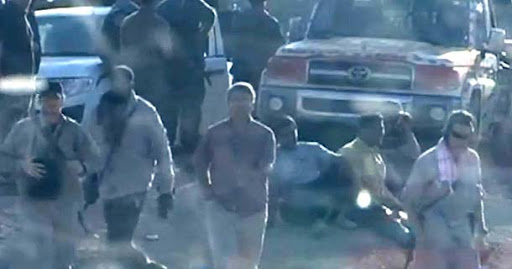
THE UK’s secret ground war in Libya is revealed today in this bombshell image of ex-SAS troops with rebels.

The elite unit is funded by the MoD via a security firm to topple Colonel Gaddafi.

David Cameron insists no British boots are on the ground in Libya. But a senior military source said: “They’re representing Britain.”

We have uncovered footage of 11 ex-SAS and Parachute Regiment soldiers in Libya training the rebels.

Blending in with the insurgents in sand-coloured clothes, peaked caps, shades and linen scarves, they are the UK’s unofficial boots on the ground.

Highly trained with front line experience round the world, the crack unit has been in the country for the past four weeks.

We spotted the elite soldiers in film taken by Arab TV station al-Jazeera in Dafniya, the western-most point of the rebel lines west of Misrata.


The elite soldiers are armed with rifles and 9mm pistols

They are armed with local versions of the AK47 rifle and 9mm pistols.

Their presence is an incredibly sensitive subject as the UN security council resolution in March authorising the use of force against Gaddafi specifically excludes “a foreign occupation force of any form on any Libyan territory”.

A senior military source said night: “These men definitely did not want to be seen by prying eyes as it could compromise their mission, which is very unofficial.

“But the fact is that they are representing Britain – whether it has been denied or not – and the British Government has given the green light for this, via a circuitous route.

“These things do happen in foreign war zones and became accepted during the Iraq War but the Government’s denial that we have boots on the ground is disingenuous to say the least.

“They are Brits and they are being paid for indirectly by the British taxpayer to a private company, whether the money was paid via a third or even fourth party.”

The ex-servicemen work for a company which has a contract with the Government and which has built up a proven track record of providing British Army military skills in conflict zones around the world.

The veterans - who are claimed to earn as much as £10,000 a month as third party “freelances” – have seen action in Iraq, Afghanistan, Columbia and Northern Ireland. Their wages have been paid to the private firm indirectly from a British Government fund.

They are part of what is known as The Circuit – an unofficial old boys network of Special Forces who work in blackspots all round the world.

Their presence comes amid Nato concern that the Libyan rebels have failed to gain enough traction to topple Gaddafi.

Top brass blame the military inexperience of the rag-tag army, made up mainly of civilians, so have unofficially sanctioned on-the-job training by UK contractors.

The elite soldiers are experts in going into conflict zones and launching what is known as “train the trainer” programmes in which they teach officers and NCOs how to prepare their troops.

Rebels desperately need this as their tactical and weapon handling skills are woeful. As well as advising rebel forces on military tactics, the group has been acting as spotters to help Nato war planes target Colonel Gaddafi’s forces. They will also be identifying targets for the imminent deployment of British and French attack helicopters on close-air support missions.

It is thought they entered Libya unofficially via Egypt in civilian vehicles. In March, six special forces soldiers and two MI6 officers were detained by rebel fighters when they landed on an abortive mission to meet insurgent leaders in Benghazi.

In what was an embarrassing episode for the SAS, the group was withdrawn soon after and this new liaison team were sent in its place. The revelations fly in the face of David Cameron’s insistence there is no mission creep in Libya.

The contract to pay for the men was acquired two months ago by a private company which works in the shadowy international security sector.

It comes amid increased speculation the UK and other Nato countries will eventually have to send in troops against crazed dictator Gaddafi.

Most experts agree that such a war – much of it conducted in urban areas – cannot be conducted without putting soldiers on the ground.

Despite more than two months of bombing by Nato, rebels have remained unable to advance west of Misrata, or west of Brega, 300 miles to the east.

The capital, Tripoli, also remains in the grip of Gaddafi, who has defied all attempts to force him to leave.

The need for a ground presence is even greater now with British Apache and French Tiger attack helicopters preparing to go in and launch close air attacks against Gaddafi’s troops. The British men are all highly trained operators with experience of war zones all over the world.

They are able to feed information back, via the private company they work for, on what equipment is needed for the rebel army.

Nato commanders usually prefer to have a Special Forces presence on the ground before they launch attack helicopters, which are vulnerable to ground-to-air missiles and rockets.

If a pilot is downed, ground forces can help secure crash sites or co-ordinate a rescue bid to lift the crew to safety.

MERCENARIES

The use of former SAS, ex-Paras and Royal Marines grew after the Iraq invasion in 2003.

Many top soldiers, sailors and airmen quit the forces to try and earn a fortune in Iraq amid rumours of people earning £1,000 a-day in danger money.

But only the top SAS and SBS men were receiving decent money as many fledgling companies eventually went bust or lost major contracts.

Many other PMCs – Private Military Companies – earned bad names, in particular American firms, for killing innocent civilians.

The company with the worst reputation was the US firm Blackwater – now re-named Xe – which still has contracts with the CIA and the American Government.

Their profile became so bad that in 2004 four of its operators were murdered by locals, torn apart and hung from a bridge in rebel town Fallujah, west of Baghdad.


Street battles raged Thursday between the army and opposition tribesmen in the capital Sanaa

Posted On 10:56 by El NACHO 0 comments

Street battles raged Thursday between the army and opposition tribesmen in the capital Sanaa and dozens of people on both sides were killed and wounded. Elsewhere a thousands-strong force of tribal fighters fought to break through government lines on the northern outskirts of the city.
The Defense Ministry issue a statement claiming the army stopped the tribesmen from entering Sanaa, but an army officer who defected from President Ali Abdullah Saleh's military, said the fighting continues.
The officer, who spoke on condition he not be named in accordance with opposition force custom, said the fighting was within 10 miles (15 kilometers) of the northern outskirts of Sanaa. He said the tribesmen had captured but later released 30 soldiers from the elite Republican Guard.
Heavy casualties were reported inside the city's Hassaba neighborhood where resident Talal Hazza said government troops were shelling opposition forces for a second day running. The army is trying to dislodge fighters loyal to pro-opposition Sheik Sadeq al-Amar.
The Defense Ministry acknowledge fighting in Hassaba for the first time Thursday. Opposition fighters have taken control of some government buildings in the region.
In the southern city of Taiz, three protesters were wounded in the fighting with the army, security men and plain-clothes government enforcers, said activist Mohammed al-Darfi.
He said security forces stormed the house of Taiz opposition lawmaker Sultan al-Samie Wednesday night and confiscated his computer and documents.
Sanaa airport was closed Wednesday night and remains shut for fear that planes could be hit in the heavy shelling around the city.


Saturday, 28 May 2011

Two Royal Marines have been killed in an explosion in Afghanistan, the Ministry of Defence (MoD) has said.

Posted On 13:10 by El NACHO 0 comments


The marines, from 42 Commando, were hit by an improvised explosive device in the Nad Ali district of Helmand province on Friday.

The MoD said they were on patrol in the Loy Mandeh area when they were killed and that next of kin had been informed.

The deaths take the number of British military deaths in operations in Afghanistan since 2001 to 368.

Spokesman for Task Force Helmand Maj Rolf Kurth said: "It is my sad duty to inform you of the death of two Royal Marines... our thoughts and prayers are with their families and friends in their time of grief."

He said they were on patrol "disrupting insurgent activity" when they were hit.

The battalion-sized formation of 42 Commando is based at Bickleigh Barracks in Plymouth, Devon.

On Monday, a British soldier from 1st Battalion the Rifles was killed by a bomb while on a patrol in the Sayedabad Kalay area of the Nahr-e Saraj district of Helmand province.


Friday, 20 May 2011

South African was shot in the stomach and abandoned by forces loyal to Gaddafi

Posted On 21:14 by El NACHO 0 comments

A South African freelance photographer missing in Libya since April is believed dead after being shot in the stomach and abandoned in the desert by forces loyal to Muammar Gaddafi, his family said yesterday.
Anton Hammerl, 41, who also had Austrian nationality and lived in London, was hit in the stomach after coming under fire on April 5, family friend Bronwyn Friedlander said in London.
South Africa and Austria criticised Gaddafi's government yesterday with Pretoria saying Libya had misled it about Hammerl and the ruling ANC also accused Tripoli of dishonesty.
Two American journalists and a Spanish photographer who were with Hammerl were taken captive by forces loyal to the Libyan leader. They could not report what had happened until their release in Tripoli on Wednesday.
According to the journalists, Hammerl was left behind bleeding while they were taken away by Gaddafi forces, Friedlander said.
"His injuries were such that he could not have survived without medical attention," she said.
"Anton was shot by Gaddafi's forces in an extremely remote location in the Libyan desert," the Hammerl family said in a statement on Facebook.
The American reporters, James Foley and Clare Gillis, spoke by telephone with Hammerl's wife Penny Sukhraj in London late on Thursday.
South Africa's foreign ministry, which said this month it had proof Hammerl was still alive, said on Friday the Libyan government had misled it about the photographer.
"We kept getting reassured at the highest level that he was alive until his colleagues were released and shared the information...," International Relations Minister Maite Nkoana-Mashabane told reporters yesterday.
Hammerl, who had three young children, had lived in Britain for five years.


Monday, 9 May 2011

NATO air attacks have hit Libyan government weapons depots near Zintan, southwest of Tripoli, the capital, according to a rebel spokesman in the town.

Posted On 12:54 by El NACHO 0 comments


Separately, two loud explosions rocked a western sector of Tripoli on Sunday as jets flew overhead, witnesses told the AFP news agency.

An international coalition began carrying out attacks on forces loyal to Muammar Gaddafi, Libya's long-time ruler, on March 19, under a UN mandate to protect civilians in the country. NATO took command of operations over Libya on March 31.

"NATO struck weapons depots five minutes ago in an area which lies about 30km southeast of Zintan," Abdulrahman, the rebel spokesman, told the Reuters news agency by telephone on Sunday.

"We heard a loud explosion ... I think the strike hit some of them [the depots].

"We are now at a cemetery burying 11 people martyred during yesterday's fighting, in which 35 other fighters were also wounded."

The reported air raids came a week after the Libyan government said that Gaddafi's son, Saif al-Arab Gaddafi, and three of his grandchildren were killed in a NATO air strike on a compound in Tripoli.

Elsewhere in the country, rebels in the contested city of Misurata clashed with government forces near the airport, a rebel spokesman told the Reuters news agency on Sunday.

"Fierce fighting is taking place now at the airport and in the air force college area [near the airport]. We are still hearing sounds of artillery and rockets," the spokesman, called Abdelsalam, said from Misurata.
   
"NATO struck an area in the east of Misurata today but we do not have details."

Fuel depots destroyed

Misurata is the last remaining city in Libya's west under rebel control. It has been under siege for more than two months and has witnessed some of the war's fiercest fighting.

On Saturday, a rebel spokesman in Misurata said that Gaddafi's forces dropped bombs on four large oil-storage tanks, destroying them and sparking a fire that spread to four more.


Click here for more of Al Jazeera's special coverage
Government forces used small, pesticide-spraying planes for the overnight attack in Qasr Ahmed close to the port, Ahmed Hassan, the spokesman, said.

"Four tanks were totally destroyed and huge fire erupted which spread to the other four. We cannot extinguish it because we do not have the right tools," he said.

"Now the city will face a major problem. Those were the only source of fuel for the city. These tanks could have kept the city for three months with enough fuel."

Commenting on the latest fighting, Al Jazeera's Hoda Abdel-Hamid, reporting from the rebel stronghold of Benghazi, said on Sunday that Libya "is showing that it is ready for any kind of foreign aggression.

"They know that it is extremely important to keep the momentum in what appears now to be a very long and protracted conflict".

Border tensions

Meanwhile, Tunisia warned on Sunday that the repeated shelling from Libya of one of its border towns may force it to take measures to protect its sovereignty.

The country's official TAP news agency said that about 80 shells from Libya had fallen on Tunisian territory.

There were no reported injuries after the shells fell as Libyan troops fought with rebels to regain control of the Wazen-Dhehiba border post.

TAP quoted the Tunisian foreign ministry as warning that the country would take "all measures needed" within the law to ensure protection of its citizens, refugees and its territory.

Tunisia summoned Libya's ambassador on April 29 to complain after shells fell in inhabited areas. It now says Libya is not keeping to its commitments.

Meanwhile Italian coast guards and local fisherman saved all 528 refugees on a boat from Libya after their vessel hit rocks off the island of Lampedusa in an operation a rescuer described as a "miracle."

Among the refugees who had thrown themselves into the water at night were 24 pregnant women.


Tuesday, 26 April 2011

Gunfire exchange between Cambodian, Thai troops continues in fifth day

Posted On 18:16 by El NACHO 0 comments

The gunfire exchange between Cambodian and Thai troops over the disputed border area at the 13th century Ta Moan temple and Ta Krabei temple in Oddar Meanchey province still continues as of 9:40 p.m. on Tuesday, said Pich Sokhin, the governor of Oddar Meanchey province.

The Tuesday's fight began at 1:40 p.m. at the 11th century Preah Vihear temple and spread to burst out at the Ta Moan temple and Ta Krabei temple at 2:10 p.m.

"It's the longest fighting today, now it has been going on for more than 7 hours, and it's still continuing," the governor told Xinhua by telephone on Tuesday night, adding that the casualties are not available yet.

He said that Thailand has been using small guns and artilleries to fire on Cambodian troops and territory.

"We have exchanged some small weapons and big ones such as BM21 in order to protect our territory from invasion," he said.

"It's reported that some of our troops are injured," he said. "And our troops reported that more Thai troops have been reported killed and injured in today's fighting."

Cambodia said that Thai troops have launched attacks on Cambodia to capture the 13th century Ta Moan temple and Ta Krabei temple, which lie 150 kilometers west of the Preah Vihear Temple.

"So far, our troops are still in firm and full control of the temple of Ta Moan and the temple of Ta Krabei," he added.

He said that as of Tuesday evening, the number of Cambodian evacuees has increased to 28,180 people.

Meanwhile, the electricity in the whole Oddar Meanchey province is cut on Tuesday night due to the fighting and some evacuees who take refuge in Samrong district in the province have continued to move to other places in order to escape from Thai artillery shelling, he added.

The latest in a series of deadly clashes between Cambodian and Thai troops have occurred for five straight days from April 22-26 at the 13th century Ta Moan temple and Ta Krabei temple in Oddar Meanchey province and on April 26 at the 11th century Preah Vihear temple, the World Heritage site.

The clashes left at least a dozen of both sides' troops killed and more than 30 injured.

The fighting has not only cost lives, damaged the temples, but also forced tens of thousands of civilians of both countries to flee for safe shelters.

The border between Thailand and Cambodia has never been completely demarcated.

Although the International Court of Justice ruled in 1962 that the Temple of Preah Vihear belonged to Cambodia, the row over the 4.6-square-km territory around the temple has never been resolved.

The conflict has occurred just a week after Cambodia's Preah Vihear temple was enlisted as a World Heritage Site on July 7, 2008, since then both sides have built up military forces along the border, and periodic clashes happened, resulting in the deaths of troops on both sides.


Monday, 25 April 2011

head of the infantry says the SAS is facing a recruitment crisis

Posted On 23:01 by El NACHO 0 comments

The head of the infantry says the SAS is facing a recruitment crisis, caused at least in part by the demands of the operations in Afghanistan.

In a letter leaked to the Daily Telegraph, Brigadier Richard Dennis said many eligible soldiers were put off applying because they did not have the time to train for demanding selection tests.

He said the "unrelentingly demanding" operations of the regular army, mean as few as a third of slots for the special forces have been filled.

Conservative MP Patrick Mercer, who is a former infantry officer, said family life also plays a part in men not signing up for selection.


Libyan leader Muammar Gaddafi was unhurt in a NATO airstrike on his Bab al-Aziziyah compound

Posted On 18:59 by El NACHO 0 comments

Libyan leader Muammar Gaddafi was unhurt in a NATO airstrike on his Bab al-Aziziyah compound early on Monday that left three people dead, a government spokesman said, calling it an assassination attempt.

Spokesman Mussa Ibrahim said it appeared to have been an attempt on Gaddafi's life, but those who died were office workers and security guards while 45 people were wounded. He said the building housed political offices.

"How is this act of terrorism protecting civilians in Libya?" he said to visiting journalists at the compound, where books spilled from an office into twisted metal and crumbled concrete. "This is a cowardly attempt to pursue one person."

He said Gaddafi was not in hiding, but was in a safe place.

"He is well, he is healthy, he is in high spirits," Ibrahim said.

Libyan state television showed pictures of Gaddafi meeting people in a tent. It said the pictures had been taken on Monday.


Syria Rolls Tanks Into Cities as Security Crackdown Kills At Least 18

Posted On 18:58 by El NACHO 0 comments

Witnesses say several thousand Syrian army troops, flanked by special forces, shot their way into the southern city of Daraa before dawn Monday, causing numerous casualties. Tanks reportedly began the assault, shelling the city as they moved in from four sides.

Videos distributed by human rights activists show black smoke over the city center and fires burning as shell-fire crackled in the background.

Reports say Syrian special forces stormed private homes to make arrests, Witnesses say snipers began shooting from rooftops and many victims remain lying in the streets.

Jordanian authorities said the main highway crossing between Jordan and Syria was closed to traffic and that two border posts were not allowing anyone to enter Syria.

Syrian rights activists say that security forces also encircled the Damascus suburbs of Douma and Madaamiya, arresting hundreds of people.

The crackdown came as Syrian government media condemned what was called the "crimes of armed gangs" and "outside plots to divide the country."  Syrian television reported that 15 members of the army and security forces were killed in recent violence.


470 prisoners, including Taliban commanders and fighters, fled overnight through a tunnel from Sarposa jail outside Kandahar.

Posted On 18:57 by El NACHO 0 comments

second time in just three years, inmates have managed to escape one of Afghanistan's biggest prisons. At least 470 prisoners, including Taliban commanders and fighters, fled overnight through a tunnel from Sarposa jail outside Kandahar.

Zabiullah Mujahid, a Taliban spokesman, told BBC Pashto that the tunnel was more than 360m (1,180ft) long and took five months to complete.

He said the tunnel led from a house north-east of the prison, which "our friends" had rented, to the political wing, where Taliban were held. It bypassed security checkpoints and the main Kandahar-Kabul road.

"We had proper digging equipment. There was so much earth from the tunnel that we carried it away gradually and sold it in the market."


The tunnel led to a mud-walled compound with a brown gate and shops on either side
"We had the support of skilled professionals - people who were trained engineers, who advised us on the digging," he added. "We managed to hit the spot where the prisoners were kept."

Police showed journalists the hole in the cement floor of the prison cell. The opening was about 1m (3ft) in diameter. The tunnel dropped straight down for about 1.5m (5ft) and appeared to go in the direction of a mud-walled compound with a brown gate and shops on either side.

There are guard towers at each corner of the prison compound, which is lit at night and protected by a ring of concrete barriers topped with razor wire. The entrance can only be reached by passing through several checkpoints.

The Taliban spokesman said three militants inside the prison had known about the plan, and that they had ushered prisoners to the tunnel.


Mohammad Abdullah, one of the inmates at Sarposa who Taliban spokesmen said had helped organise the escape, said "friends" had managed to obtain copies of the keys to the cells beforehand, suggesting collusion by the guards.

"When the time came at night, we managed to open the doors for friends who were in other rooms," he told the Associated Press.

Zabiullah Mujahid added: "In order to make sure it went smoothly, they only woke people up a few at a time, room by room. This was to keep the escape secret and to make sure the guards didn't know what was going on.

"People escaped in small numbers, room by room - this avoided overcrowding and noise. It was all very professional."


The tunnel dropped straight down for about 1.5m (5ft) from the cell floor
He said there had been no guards inside the cell where the tunnel emerged.

"At the other end, in the house where the tunnel started, we positioned suicide bombers so that if something happened, if fighting broke out, they could respond," he added.

He said 541 prisoners were able to escape during the operation, which began at about 2300 local time on Sunday and ended at 0330 on Monday morning.

Officials declined to provide details on any of the escaped inmates, but another Taliban spokesman said about 106 of the inmates were commanders - four of them former provincial chiefs.

The escapees were taken in vehicles to a "safe places" and then the Taliban alerted the media about what had just happened, Zabiullah Mujahid added. The prison authorities knew nothing about the escape until then, he claimed.

Officials at Sarposa prison say they discovered the breach at 0400.


In June 2008, the Taliban orchestrated the escape of more than 900 prisoners at Sarposa
The governor of Kandahar province, Tooryalai Wesa, said the breakout was "absolutely the fault of the ignorance of the security forces".

"This was not the work of a day, a week or a month of activities, this was actually months of work they spent to dig and free their men."

The police have mounted a massive search operation for the inmates. Officers had already rearrested 26 and shot two who tried to flee, Mr Wesa added.

But Zabiullah Mujahid denied that some of them had been found.

"These claims that they have recaptured people are untrue. They are just saying that to justify their negligence," he said.

In June 2008, the Taliban orchestrated the escape of more than 900 prisoners at Sarposa, including hundreds of militants, in an attack that killed 15 guards. A suicide bomber was used to blast open the gates.


Thursday, 21 April 2011

”Restrepo” director Tim Hetherington killed in Libya

Posted On 09:58 by El NACHO 0 comments

Fighting in Libya's besieged rebel city of Misrata killed at least 10 civilians including an Oscar-nominated British filmmaker, and NATO urged non-combatants to avoid troops so it could step up air strikes.

Among the dead were British photojournalist Tim Hetherington, co-director of Oscar-nominated war documentary "Restrepo," and American photographer Chris Hondros, killed when a group they were in came under mortar fire.

Seven Libyan civilians and a Ukrainian doctor were also killed during fierce fighting in Libya's third largest city, medics said.

France promised the insurgents on Wednesday it would intensify air strikes on Libyan government forces and dispatch military liaison officers, echoing a move by Britain, to help organize poorly trained insurgents.

Rebels said they were battling for control of a major road in Misrata, a port of 300,000 people and the insurgents' last bastion in the west of the country, where civil war ignited in February over demands for an end to Gaddafi's 41-year rule.


Cornish photographer has been seriously injured working in Libya.

Posted On 09:56 by El NACHO 0 comments

Guy Martin, 28, from Falmouth, was covering fighting in the besieged city of Misrata when he was hit by shrapnel from a mortar.

It is thought Mr Martin suffered leg and stomach injuries. He is in a serious but stable condition in hospital.

Another British photographer, Tim Hetherington, and US photographer Chris Hondros, were killed.

Mr Martin was working with Panos Pictures agency when he was hurt.

He underwent hours of surgery at a local hospital, his girlfriend Polly Fields told BBC Radio Cornwall.

"We've had some positive news overnight," she said.

"They have confirmed that Guy has been stabilised. He had a wound to his stomach.

"He was in surgery for about six to eight hours. He's come out of that now. Now it's a case of getting him stable enough so he can be evacuated from Misrata."

Miss Fields said Mr Martin was travelling with a group of photographers when they came under mortar fire.

Mr Martin has worked for national and international publications in many countries including Iraq, Sudan and Russia. Earlier this year he covered the uprising in Egypt.

His work has appeared in a number of national newspapers including the Guardian, the Observer and the Sunday Times.


Tuesday, 19 April 2011

Spain: U.N. won't bless expanded armed intervention in Libya

Posted On 20:03 by El NACHO 0 comments

A second U.N. Security Council authorizing expanded armed intervention in Libya is "impossible," Spain's defense minister said here Tuesday, adding that the goal of the current military operation should be to "create spaces for politics."

The Spanish government wants to see strongman Moammar Gadhafi depart Libya "as soon as possible," but regime change is not the aim of the U.N.-approved military operation, Carme Chacon told the defense committee of the lower house of Parliament.

She appeared before the committee to ask for a two-month extension of Spain's role in enforcing the no-fly zone over Libya, as well as possible Spanish assistance for U.N.-authorized operations providing humanitarian aid.

The minister said that the Spanish government wants both Gadhafi to step down and a cease-fire to be declared.

But she insisted that the goal of the military operation is to protect the civilian population by establishing a no-fly zone and a naval embargo to prevent arms and mercenaries from entering Libya.

"That is the mission of the (Spanish) armed forces...and nothing else," Chacon said.

The defense minister acknowledged that Libya runs the risk of becoming a "failed state," something that she said must be "avoided at any price" by supporting diplomatic endeavors.

Now, she said, the allies are asking Spain to continue helping maintain the no-fly zone for two more months, since a total of three months is a period that has been considered "reasonable" by both the United Nations and NATO.

She said that any new mission of humanitarian aid, in case the United Nations requests it, will consist for the Spanish armed forces of escort duties for the evacuation of civilians by air or sea, and the provision of ships for carrying food, medicine and other needed goods.


Minister claims France and UK 'violating' UN mandate as Nato airstrikes hit pro-Gaddafi communication centres

Posted On 20:01 by El NACHO 0 comments

The Anglo-French decision to send a team of military advisers to Libyan opposition forces in Benghazi is a "clear violation" of the UN security council remit, Muammar Gaddafi's deputy foreign minister, Khaled Kayim, has told the Guardian. "No one can legitimise such actions. They will get nothing in return apart from more casualties."

He accused Nato and the international coalition of overstepping the limits of the UN security council resolution authorising military action to protect civilians, saying they were "siding with the rebels. Everything they have been doing since the start is outside the mandate."

Libya's response came as fighting continued in Misrata and efforts intensified to bring in humanitarian aid to the population and evacuate those trapped in the besieged city. The Libyan government denied there was any bombardment by its forces.

Kayim said: "I think this is a big trap for Britain and France. They are dealing with the wrong groups. I can't understand why Britain and France are so keen to get themselves into trouble and in this trap."

The two western countries would find themselves allied with al-Qaida forces, he said, which pro-Gaddafi forces claim are embedded with the rebels.

The Anglo-French move followed Nato airstrikes which destroyed three telecommunications installations around the city of Sirte on Monday, according to the Libyan government.

Nato's goal was to cut off communications, Kayim said. "The aim is clear: to enable the rebels to advance and to cut communications between [government] troops." A large area around Sirte was without communications although the city centre was still functioning, he said.

Nato confirmed that communications infrastructure had been targeted and the headquarters of a Libyan army brigade. "Last night we conducted deliberate multiple strikes against command and control facilities of the Gaddafi regime, including communications infrastructure and a 32nd brigade headquarters located 10km south of Tripoli," Brigadier General Mark van Uhm said at Nato headquarters in Brussels.

The airstrikes on communications centres came "at the same time as the British government sends very sophisticated tele communications equipment to the rebels to enable them to organise themselves", Kayim told a press conference in Tripoli. He added: "If Nato really cared about civilians, they have to stop the airstrikes and stop siding with the rebels. Their aim is to push the country into a civil war. That's clear from day one."

He warned against any deployment of ground troops to protect humanitarian missions, as floated by the EU. "If there is any deployment of any armed personnel on Libyan ground, there will be fighting. The Libyan government will not take it as a humanitarian mission, it will be taken as a military mission," he said. "The Libyan people will not stay silent. They will join the armed forces and fight."

He said the Libyan government was doing its utmost "to help people and supply them with food", but he repeatedly declined to answer questions about whether Libya would agree to a pause in military action to allow humanitarian aid to reach the besieged city of Misrata.

"There is no need for such things. There is no bombardment from the armed forces on Misrata, none at all. There are pockets of resistance, but other areas are peaceful. There is no fighting in Misrata."

His claim contradicted witness accounts from inside the city and a Nato statement that Gaddafi's forces were shelling Misrata indiscriminately. Nato said its operations had inflicted "quite significant damage" to Libya's heavy weaponry while warning that Gaddafi's forces still had "considerable" resources left.

"But there is a limit to what can be achieved with airpower to stop fighting in a city. We are taking every precaution to avoid causing civilian casualties by our own air operations," said Van Uhm.

Admiral Giampaolo di Paola, chairman of Nato's military committee, speaking in Rome, said it was proving "very difficult" to strike against government forces in Misrata without inflicting civilian casualties. "It's not a conventional war," he added.

Witnesses in Misrata report that government snipers were firing from tall buildings and mosques.

The Libyan opposition claimed that 10,000 people had been killed since the start of the uprising, and more than 50,000 injured. It was unclear how casualty figures had been documented.

Kayim claimed the international coalition was exaggerating the number of casualties in Misrata: "This is all shit."

Opposition forces in Misrata say the city may be lost within days without increased military action from Nato, and they have appealed for troops to protect the passage of humanitarian aid through the bombarded port. The city is surrounded by government forces on all land sides; the port is the only means of access to and from the area controlled by opposition forces.

They say that around 1,000 people have been killed since the siege began in late February. More than 300 have been confirmed dead in the city's hospitals.

The UN's World Food Programme said on Tuesday it had sent eight trucks loaded with wheat flour and high-energy biscuits into government-controlled western Libya to reach areas affected by fighting. Battles between opposition forces and government troops have continued near the Tunisian border.


SAS raids were possible for specific missions.

Posted On 19:58 by El NACHO 0 comments

British Army officers are being sent to Libya to advise rebels fighting Colonel Muammar Gaddafi's forces.
The UK group will be deployed to the opposition stronghold of Benghazi, Libya's second city, in a mentoring role to help leaders co-ordinating attacks on the dictator's army.
The announcement came after a Royal Navy submarine launched cruise missiles on Libyan targets, with RAF warplanes attacking communication masts.
The handful of experienced officers will join a British team in Benghazi working with the opposition National Transitional Council (NTC), which UK Foreign Secretary William Hague described as "legitimate political interlocutors".
Mr Hague said the Army officers would help prevent attacks on civilians, in line with the United Nations Security Council resolution authorising military action against Gaddafi's forces.
He said: "These additional personnel will enable the UK to build on the work already being undertaken to support and advise the NTC on how to better protect civilians.
"In particular they will advise the NTC on how to improve their military organisational structures, communications and logistics, including how best to distribute humanitarian aid and deliver medical assistance."
The Foreign Secretary added: "Our officers will not be involved in training or arming the opposition's fighting forces. Nor will they be involved in the planning or execution of the NTC's military operations or in the provision of any other form of operational military advice."
Britain has supplied rebels with body armour and telecommunications equipment and the Government on Monday pledged £2 million to help thousands of stranded civilians flee war-torn Misrata by boat.
Speaking later to Sky News, Mr Hague again ruled out a ground invasion to unseat Gaddafi, but admitted further SAS raids were possible for specific missions.


Related Posts Plugin for WordPress, Blogger...